

Table of Content
Paying employees the legally prescribed minimum wage is a basic responsibility for every employer. Yet, businesses can run into compliance issues when they use outdated wage rates, classify employees incorrectly or fail to account for changes in Dearness Allowance (DA). Even a small payroll error can lead to wage claims, penalties and disputes with employees.
The minimum wage in Delhi varies according to the employee’s skill category and, for clerical and supervisory staff, their educational qualifications. Employers must follow the latest government notifications and maintain accurate payroll records.
Here’s what businesses need to know about the applicable rates, legal requirements and compliance responsibilities.
Minimum wage is the lowest wage an employer can legally pay an employee. In Delhi, the applicable rate depends on the employee’s skill category and the government-notified wage rates.
The Code on Wages, 2019, which came into effect on 21 November 2025, governs minimum wage requirements in India. It replaced the Minimum Wages Act, 1948, along with three other labour laws.
In Delhi, the Labour Department, Government of NCT of Delhi, notifies the applicable minimum wage rates. Under Section 69 of the Code, existing notifications and orders continue to apply, provided they are consistent with the Code, until they are replaced or withdrawn.
Worried About Minimum Wage Non-Compliance?
Stay compliant with updated wage requirements and ensure employees receive their legally applicable wages.
The Delhi Labour Department’s latest listed minimum wage order is dated 15 April 2025 and took effect on 1 April 2025. It specifies different rates for workers based on their skill levels and for clerical and supervisory employees.
| Employee category | Monthly minimum wage | Daily minimum wage |
|---|---|---|
| Unskilled | ₹18,456 | ₹710 |
| Semi-skilled | ₹20,371 | ₹784 |
| Skilled | ₹22,411 | ₹862 |
| Clerical/supervisory: Non-matriculate | ₹20,371 | ₹784 |
| Clerical/supervisory: Matriculate but not graduate | ₹22,411 | ₹862 |
| Clerical/supervisory: Graduate and above | ₹24,356 | ₹937 |
These rates include basic wages and Dearness Allowance (DA). Employers must pay at least the applicable minimum wage for each employee category.
Important: On 14 October 2025, the Delhi Labour Department clarified that a wage revision order circulating online, claiming to introduce new rates from 1 October 2025, was fraudulent. Employers should verify any wage revision through the official Delhi Labour Department website before updating payroll.
Delhi’s minimum wage notification sets separate rates for unskilled, semi-skilled and skilled workers. It also provides three wage categories for clerical and supervisory staff, based on educational qualifications.
Labour Department Delhi+1
These employees perform simple, routine duties that require little independent judgement or prior experience. The work may involve physical effort and basic familiarity with the workplace.
These employees handle routine tasks that require some practical knowledge or training. Their work generally follows established procedures, with important decisions or complex tasks handled by others.
These employees need specialised knowledge or experience to perform their duties efficiently. They can use independent judgement and take responsibility for their work.
Delhi classifies clerical and supervisory employees according to their educational qualifications:
Employers should apply the category specified in the relevant wage notification. They should assess the nature of the work and the employee’s qualifications rather than rely on job titles alone.
Facing Challenges with Employee Wage Calculations?
Simplify wage calculations with professional payroll support and accurate compliance management.
Delhi’s minimum wage includes basic wages and Dearness Allowance (DA). DA is adjusted based on changes in the Consumer Price Index (CPI).
For example, under the April 2025 notification, an unskilled worker’s monthly basic wage is ₹18,066, with a DA of ₹390. The total minimum wage is ₹18,456 per month or ₹710 per day.
Employers must use the applicable notified rate and follow wage-period rules when calculating pay for employees who work only part of a wage period.

Under the Code on Wages, 2019, employers must meet minimum wage requirements and maintain proper wage records. Their key responsibilities include:
Pay every covered employee at least the applicable notified minimum wage. Employee consent or an employment agreement cannot justify underpayment.
Classify employees based on their actual duties and skill levels. Review these categories when their job responsibilities change.
Monitor official notifications and update payroll when revised rates take effect. Pay any arrears due under retrospective revisions.
Pay wages within the prescribed deadlines and make only legally permitted deductions.
Maintain prescribed registers and records of employee details, attendance, wages and payments, as required under Section 50 of the Code.
Check that contractors pay their workers the applicable minimum wages. Review wage and payment records to identify any shortfalls.
Regular payroll checks and accurate records help employers prevent underpayment and address compliance gaps.
Employers who pay less than the notified minimum wage can face legal action and financial penalties under the Code on Wages, 2019.
Under Section 54, a first offence can attract a fine of up to ₹50,000. A repeat offence within five years can result in imprisonment of up to three months, a fine of up to ₹1 lakh, or both.
Employers may also be directed to pay wage arrears and applicable compensation to affected employees.
Unsure Which Wage Category Applies to Your Employees?
Get expert assistance in identifying employee categories and applying the correct minimum wage rates.
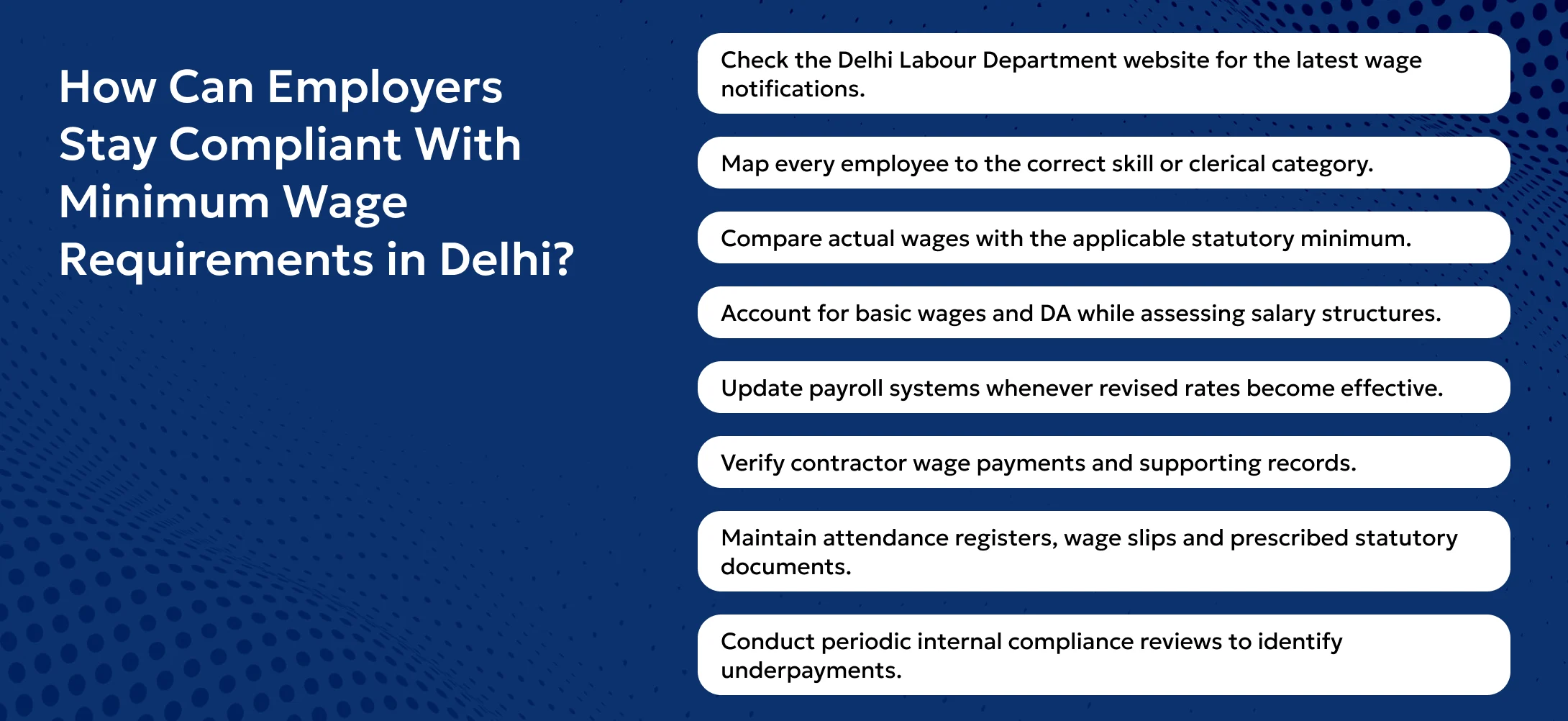
Keeping up with wage notifications and maintaining accurate records can help businesses avoid common compliance mistakes. HR and payroll teams should follow a regular review process.
Here are some important steps:
A documented review process also makes it easier to address discrepancies and demonstrate compliance during inspections.
Keeping up with minimum wage notifications, employee classifications and payroll requirements can be challenging. Vishaal Consultancy Services supports businesses across India with labour law compliance and advisory services, helping them identify gaps and meet their statutory obligations.
Our services include:
With pan-India service coverage, we help businesses address labour law requirements across their locations. Contact Vishaal Consultancy Services to review your wage practices and strengthen your compliance processes. For help applying revised wage rates, explore our payroll services in Delhi.

Delhi’s minimum wage compliance requires accurate employee classification, timely wage payments and up-to-date payroll records. Employers must also track wage revisions and ensure contractors meet their payment obligations. Regular compliance checks can help prevent underpayment, penalties and employee disputes.
Vishaal Consultancy Services helps businesses meet labour law requirements through compliance health checks, gap analysis and labour law advisory. Contact us to review your wage practices, identify gaps and avoid costly compliance issues.
Want to Avoid Labour Law Compliance Issues?
Manage wage payments, statutory requirements and payroll responsibilities with reliable compliance support.
See Related Blogs
BLOGS
BLOGS
Fill in your details to download our New Labour Code PDF.
Fill in your details to download our exclusive e-learning document.
Fill in your details to download our exclusive e-learning document.
Fill in your details to download our exclusive e-learning document.