

Table of Content
The new financial year has started, and for most employers, payroll reviews are already in motion. This time, it feels a little different with the new salary structure is now in effect following the notification of final central rules on 8 May 2026.
If your current salary setup isn’t aligned, the impact may not show immediately. But over time, it can affect compliance, cost planning, and even how employees understand their pay. And when the rules come into effect, making changes in a rush can create unnecessary confusion.
In this blog, we’ll break down the new salary structure in India in a simple and clear way, so employers understand what’s changing and how you can prepare without added pressure.
The new labour code salary structure comes from the Code on Wages, 2019. It introduces a standard definition of wages that all employers need to follow.
Earlier, companies had more flexibility in structuring salaries. Now, salary components must be aligned with this defined wage structure.
So before making any changes, it’s important to understand what counts as wages and what doesn’t. This is where the 50% rule comes in.
Not sure whether your current salary structure is aligned with the latest labour-law requirements? Let our experts review it
The 50% rule is the core of the new salary structure. It defines how much of the salary must be treated as wages.
Here’s how it works:
What is excluded from Wages:
Example:
An employee with a monthly CTC of ₹60,000 where basic pay is ₹20,000 (33%) needs restructuring.
| Component | Before | After |
|---|---|---|
| Basic Pay | ₹20,000 (33%) | ₹30,000 (50%) |
| Allowances | ₹40,000 (67%) | ₹30,000 (50%) |
| PF (Employer, 12%) | ₹2,400 | ₹3,600 |
| Gratuity impact | Lower | Higher |
| Take-home | Higher | Slightly lower |
| Total CTC | ₹60,000 | ₹60,000 |

| Component | Old Salary Structure | New Salary Structure |
|---|---|---|
| Basic Salary | Typically, 30–40% of CTC | Often increases due to wage rules |
| Allowances | Larger share, flexible | Limited beyond threshold |
| PF Contribution | Lower | Higher |
| Gratuity | Lower payout | Higher payout |
| Take Home Salary | Slightly higher | May reduce slightly |
| Compliance | Less structured | Clearly defined |
Avoid payroll and statutory compliance gaps by ensuring your salary components are structured correctly.
Salary components need to be reviewed because the way wages are defined has changed. Since PF and gratuity are now calculated based on this definition, even small changes in salary structure can affect overall cost and compliance.
Here’s what changes:
The new salary structure changes how salaries are planned and how benefits are calculated. Since wages now form a larger part of the salary, it directly affects both employer costs and employee earnings.
For employers, the impact is mostly on cost and compliance. PF and gratuity contributions increase because they are linked to wages. At the same time, there is less flexibility in structuring salaries, and payroll systems may need updates to stay aligned with the rules.
For employees, the impact is seen in take-home pay and long-term benefits. Take-home salary may reduce slightly, but higher PF and gratuity contributions improve overall financial security over time.
Need help restructuring salaries without creating unnecessary payroll or compliance complications?
Aligning your salary structure with the new wage rules early can save a lot of effort later, and a structured approach works better than quick fixes.
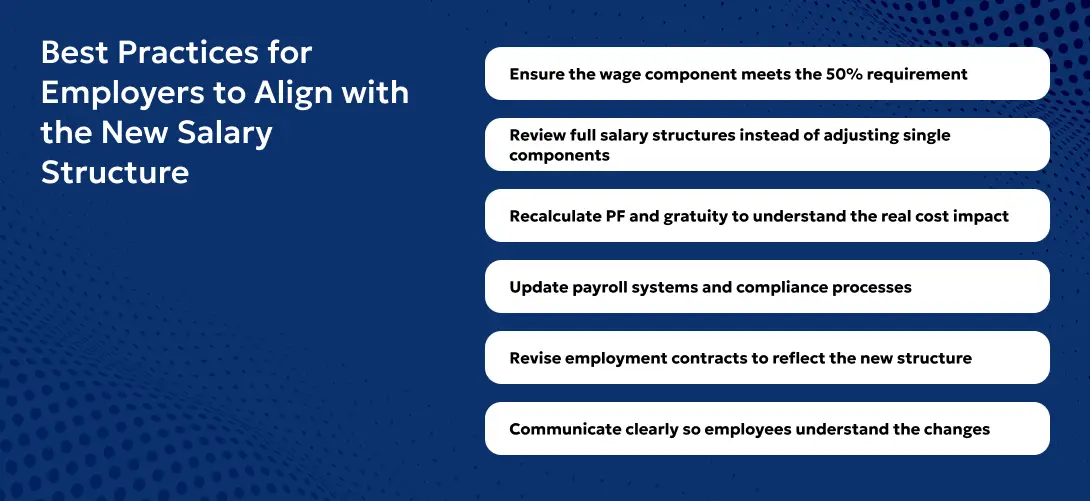
Review your salary structure, payroll processes, and statutory contributions with experienced compliance professionals.
The four Labour Codes were officially notified on 21 November 2025, with full enforcement targeted from 1 April 2026. The final central rules under all four codes were notified on 8 May 2026.
Since labour is a concurrent subject under the Constitution, state-level implementation varies:
What this means for employers:
Managing the shift to the new salary structure can feel confusing, especially when multiple compliance rules are involved. Vishaal Consultancy Services helps employers review salary structures, identify gaps, and align everything with current labour law requirements.
Our experts also support payroll updates, policy changes, and documentation, so you don’t miss anything important. This way, you can stay compliant, avoid costly errors, and handle the transition with more clarity.

The new salary structure in India changes how employers approach compensation. It brings more structure into salary planning and connects pay more closely with long-term benefits like PF and gratuity. Once you understand how the wage definition works, the transition becomes much easier to manage in practice.
If you’d rather not figure this out on your own, getting expert help can save time and reduce risk. Vishaal Consultancy Services can guide you through the process, help you stay compliant, and make sure your payroll systems are aligned without unnecessary complications.
Make your transition to a compliant salary structure smoother for both your business and employees.
The rule states that wages must be at least 50% of total remuneration. If exclusions like allowances exceed this limit, the excess amount is added back to wages. This directly affects PF and gratuity calculations.
Not necessarily. If your basic pay is already at or above 50% of CTC, there is no change. If it is below 50%, your employer will need to restructure your salary. Take-home pay may reduce slightly, but PF and gratuity savings increase correspondingly. Total CTC does not change.
Yes. The final central rules were notified on 8 May 2026. However, state-level enforcement varies. Karnataka, Maharashtra, and Kerala have notified their state rules. Employers should check their specific state’s notifications and begin compliance immediately.
No. The Ministry of Labour confirmed in its March 2026 FAQ that annual performance-based incentives do not form part of “wages” for statutory calculations under the Labour Codes
See Related Blogs
BLOGS
Fill in your details to download our New Labour Code PDF.
Fill in your details to download our exclusive e-learning document.
Fill in your details to download our exclusive e-learning document.
Fill in your details to download our exclusive e-learning document.