

Table of Content
Employee leave management is essential for workplace discipline, business continuity, and legal compliance. A clear leave policy helps employees understand their entitlements and responsibilities while giving employers a structured process for managing absences.
A recent Chhattisgarh High Court case reinforced the importance of proper leave management. An employee was terminated after remaining absent beyond his approved leave period, leading the court to examine whether the employer had followed the required disciplinary process.
In this blog, we’ll explain the key legal requirements governing a leave policy in India as per new Labour Law, discuss common challenges employers face, and share practical steps to help organisations build a compliant and effective leave management system.
A leave policy in India is a written document that defines the types of leave available to employees, their eligibility, the approval process, and the rules for availing and tracking leave. It provides a clear framework for managing employee absences and ensuring compliance with applicable new Labour Laws.
A leave policy in India as per new Labour Law should be based on the relevant central and state laws applicable to the organisation and clearly communicate employees’ leave entitlements and responsibilities.
Leave compliance is not just about granting time off. It is about meeting legal obligations and reducing business risk.
A poorly drafted or non-compliant leave policy can lead to:
Is your company’s leave policy legally compliant and suited to your workforce? Let our experts review it.
The legal framework governing leave in India comes from a combination of central and state-specific legislation. Employers must review all applicable laws before drafting or updating their policies.
| Law | Key Leave-Related Provisions |
|---|---|
| Factories Act, 1948 | Eligible workers who satisfy prescribed service requirements, including qualifying days worked, may receive annual leave with wages. |
| Maternity Benefit Act, 1961 | Eligible women employees can receive maternity benefits and leave as prescribed under the Act. |
| Employees’ State Insurance Act, 1948 | Provides sickness, maternity, and certain other benefits to eligible insured employees subject to contribution requirements. |
| State Shops and Establishments Acts | Regulate leave entitlements, holidays, and working conditions for shops and commercial establishments. Rules vary from state to state. |
Every leave policy should clearly define the types of leave available to employees and the conditions for availing them. While entitlements vary based on applicable laws and company policies, the most common leave categories include:
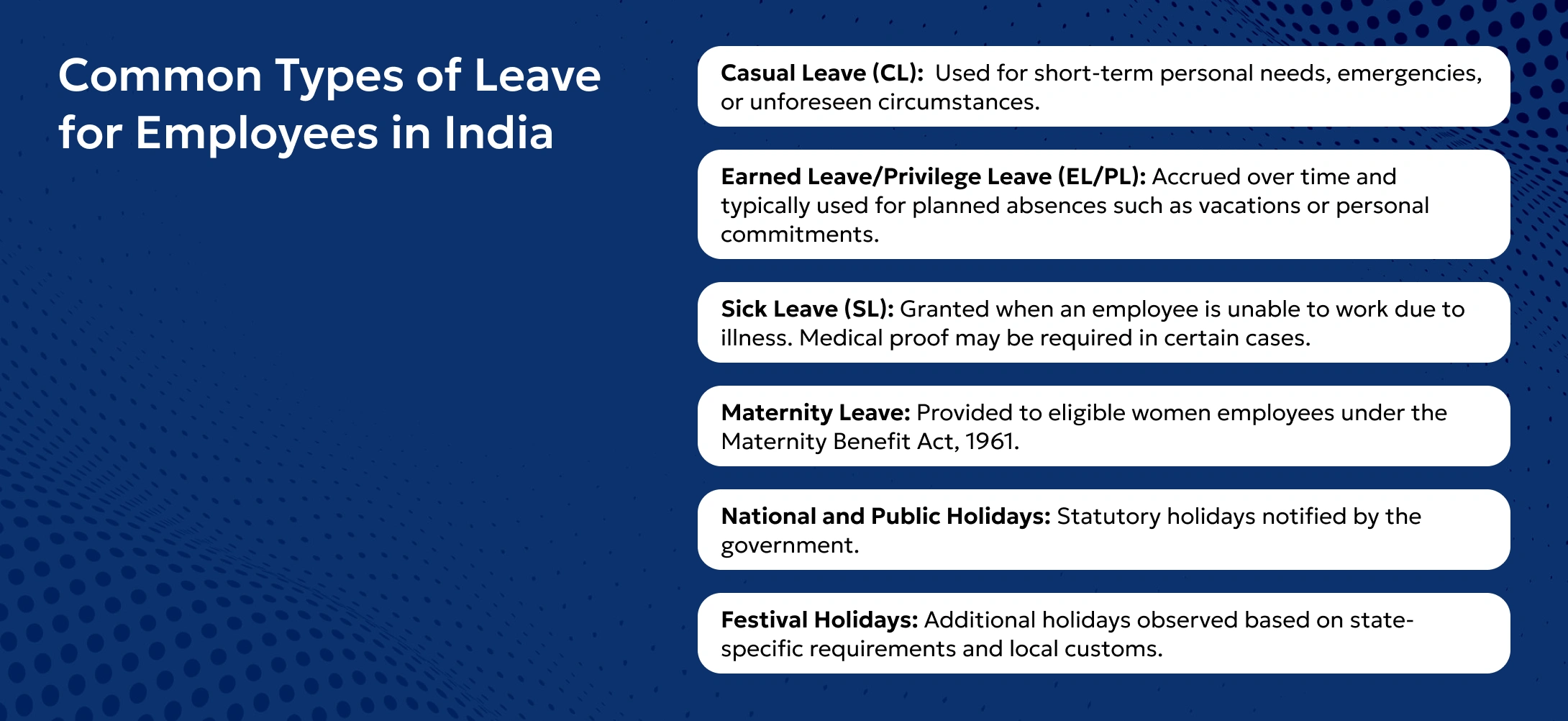
Avoid confusion and employee disputes with a clear, compliant and professionally structured leave policy.
Having a leave policy is one thing. Implementing it consistently and compliantly is another. Many organisations face challenges that can lead to disputes, operational disruptions, and compliance risks.
1. Understanding Legal Requirements
Applying the same leave policy across all locations without considering state-specific laws can result in compliance gaps.
2. Managing Multi-State Workforces
Different states have different leave entitlements, holiday requirements, and regulatory obligations, making policy administration more complex.
3. Leave Misuse and Unauthorised Absences
Frequent last-minute leave requests and unexplained absences can disrupt operations, affect productivity, and strain team resources.
4. Inaccurate Leave Records
Errors in leave tracking can lead to incorrect balances, payroll issues, and employee disputes.
5. Lack of Policy Awareness
Unclear communication often results in misunderstandings about leave entitlements, approval processes, and employee responsibilities.
Addressing these challenges requires clear policies, accurate record-keeping, and consistent implementation across the organisation.
1. Review Laws
2. Define Entitlements
3. Set Procedures
4. Document Rules
5. Digitise Tracking
6. Train Teams
Ensure HR personnel and managers understand the policy, legal requirements, and their role in administering leave fairly and consistently.
Following these steps helps organisations create a leave policy that is transparent, compliant, and easy to implement.

Need to draft or update your organisation’s leave policy according to applicable labour requirements?
The Situation
A recent case before the Chhattisgarh High Court involved a court employee who applied for leave for his wedding. While part of the leave request was approved, the remaining period was denied. Despite this, the employee remained absent beyond the approved duration.
The employer responded by terminating his services.
Where the Employer Went Wrong
The issue before the court was not simply the employee’s absence. The employer failed to conduct a proper inquiry before imposing a serious disciplinary penalty.
The court found that the termination carried a stigma and that the employee hadn’t been given a fair opportunity to defend himself. As a result, the dismissal was challenged successfully.
Key Lessons for Employers
This case offers valuable compliance lessons:
A strong leave policy in India as per new Labour Law shouldn’t only explain leave entitlements but also establish clear procedures for handling violations fairly and consistently.
Build a leave policy that balances employee entitlements, business continuity and statutory compliance.
Creating legally compliant leave policies for employees in India requires more than copying templates from the internet. Every organisation has different compliance obligations depending on its location, industry, workforce structure, and applicable laws.
At Vishaal Consultancy Services, we help businesses:

A well-drafted leave policy in India as per the new Labour Law helps organisations manage employee absences, meet compliance requirements, and maintain consistency across the workplace. Clear leave rules, proper documentation, and structured approval processes can reduce disputes, improve transparency, and support effective workforce management.
If your organisation needs help drafting, reviewing, or updating its leave policy, Vishaal Consultancy Services can help. Our experts ensure your policies align with applicable new Labour Laws and business requirements, helping you minimise compliance risks and manage leave with confidence.
Make leave management easier for your HR team with policies designed around your business and workforce.
See Related Blogs
BLOGS
Fill in your details to download our New Labour Code PDF.
Fill in your details to download our exclusive e-learning document.
Fill in your details to download our exclusive e-learning document.
Fill in your details to download our exclusive e-learning document.