Vishaal Consultancy Services

Home / blogs / Code on Social Security: What Indian Employers Must Know in 2026

Code on Social Security: What Indian Employers Must Know in 2026

Code on Social Security

Introduction

Managing labour law compliance in India is becoming more complex for employers in 2026. Many businesses are still unsure about how the Code on Social Security affects PF contributions, payroll structures, gratuity, contractor management, and employee welfare compliance.

For companies handling growing teams and multiple vendors, this uncertainty can lead to payroll mistakes, delayed registrations, and contractor compliance gaps. Many organisations are also continuing with older HR and payroll practices without preparing for the changes expected under the social security code for 2026.

This may increase legal and operational risks later. In this blog, we’ll explain the key changes employers should know, how the legislation may affect businesses, and the practical compliance steps companies should start taking now.

What Is the Code on Social Security?

The Code on Social Security is one of India’s four labour codes that brings multiple employee welfare laws under one framework. It covers statutory benefits such as Provident Fund (PF), Employee State Insurance (ESI), gratuity, maternity benefits, employee compensation, and social security coverage for certain gig and platform workers.

The social security code 2020 created the legal framework for these reforms, while the social security code for 2026 is expected to increase focus on payroll compliance, statutory documentation, and employee benefit management.

The code consolidates major labour laws, including:
  • Employees’ Provident Funds and Miscellaneous Provisions Act, 1952
  • Employees’ State Insurance Act, 1948
  • Payment of Gratuity Act, 1972
  • Maternity Benefit Act, 1961
  • Employee Compensation Act, 1923
  • Unorganised Workers’ Social Security Act, 2008
As multiple welfare laws now fall under one structure, employers need stronger payroll systems, documentation practices, and compliance monitoring processes.

What Employers Should Know About the Social Security Code for 2026

The social security code for 2026 increases focus on payroll transparency, contractor compliance, employee benefit coverage, and statutory documentation. If your business manages growing teams, vendors, or flexible staffing models, strengthening your compliance systems early can help you avoid future risks.

  1. Wider Workforce Coverage: The framework expands coverage to gig workers, platform workers, fixed-term employees, and certain contract workers. If you rely on flexible hiring, you may need stronger documentation and workforce tracking.
  2. Revised Wage Definition: The updated wage definition affects PF contributions, gratuity calculations, and statutory payments. Businesses using allowance-heavy salary structures should review payroll planning carefully.
  3. Stronger Contractor Compliance: If you work with contractors or staffing agencies, you should regularly verify wage records, PF deposits, and ESI compliance.
  4. Digital Compliance Systems: The government continues shifting toward online filings and centralised compliance systems, making organised payroll and documentation management more important for employers.
These changes can affect startups, manufacturing units, service companies, and contractor-driven businesses across India.
Code on Social Security

Is the Code on Social Security Fully Implemented in 2026?

The Code on Social Security has been enacted, but implementation still depends on notifications issued by the Central Government and individual states. As a result, compliance timelines and operational rules may vary across India.

But employers should not treat this as a reason to delay preparation. Many businesses have already started restructuring payroll systems, reviewing wage definitions, and tightening contractor compliance because future labour law enforcement is expected to align more closely with the code.

Key Employer Responsibilities Under the Code on Social Security 2026

The Code on Social Security places greater responsibility on employers to manage payroll, statutory contributions, employee benefits, and labour records properly. Businesses that continue using outdated compliance systems may face penalties, disputes, and operational challenges later.
  • PF Compliance: You must ensure timely PF registration, correct contribution calculations, and proper wage classification because incorrect salary structures may create compliance issues during inspections.
  • ESI Compliance: Eligible establishments must register under ESI and deposit contributions within timelines to avoid penalties, delayed payments, and backdated liabilities.
  • Gratuity Management: You should review gratuity eligibility carefully, especially for fixed-term employees, and maintain proper settlement records to reduce employee disputes.
  • Contractor Compliance: If you work with contractors or staffing agencies, you should regularly verify their PF, ESI, wage payment, and employee records because principal employers may still face liability for non-compliance.
  • Employee Welfare Benefits: Your HR policies should comply with maternity benefit and employee welfare requirements since outdated practices may increase legal and reputational risks.
  • Labour Documentation: You should maintain accurate payroll records, attendance registers, employee agreements, and statutory filings because missing documents can create serious issues during labour inspections.
These responsibilities affect not only legal compliance but also your day-to-day workforce and payroll management.

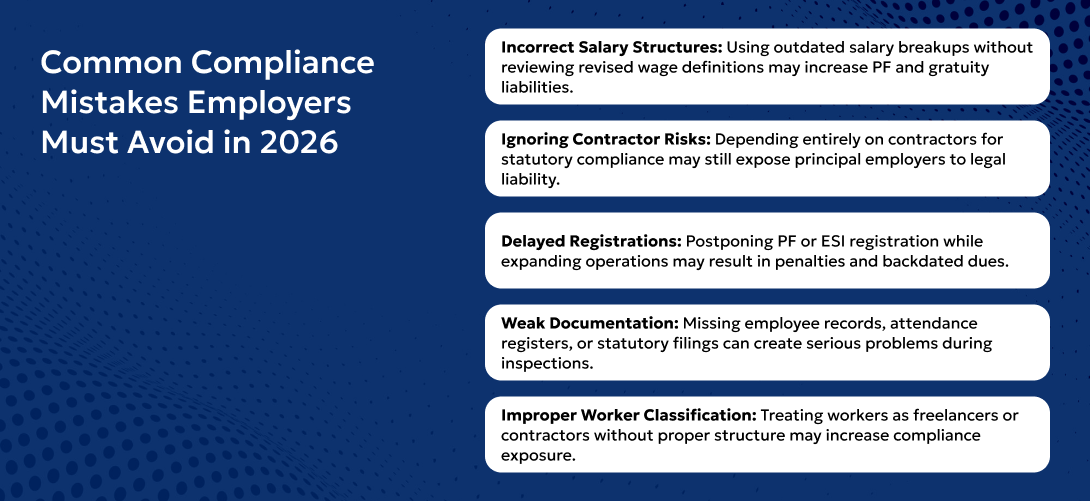
Common Compliance Mistakes Employers Must Avoid in 2026

Many compliance issues happen because businesses continue using outdated payroll and HR practices without reviewing changing labour law requirements.
  • Incorrect Salary Structures: Using outdated salary breakups without reviewing revised wage definitions may increase PF and gratuity liabilities.
  • Ignoring Contractor Risks: Depending entirely on contractors for statutory compliance may still expose principal employers to legal liability.
  • Delayed Registrations: Postponing PF or ESI registration while expanding operations may result in penalties and backdated dues.
  • Weak Documentation: Missing employee records, attendance registers, or statutory filings can create serious problems during inspections.
  • Improper Worker Classification: Treating workers as freelancers or contractors without proper structure may increase compliance exposure.
Avoiding these mistakes requires employers to review compliance practices more proactively instead of reacting only during audits or disputes.
Code on Social Security

How Employers Can Prepare for the Social Security Code for 2026

Businesses that prepare early are more likely to handle labour law changes smoothly without disrupting daily operations or payroll systems.

  • Audit Existing Compliance Systems: Review current payroll processes, employee benefits, and statutory obligations to identify gaps early.
  • Align Payroll Policies: Ensure salary structures and wage components match updated compliance expectations under the code.
  • Update Internal Documentation: Employment contracts, HR policies, and contractor agreements should reflect current workforce practices and labour law requirements.
  • Train Internal Teams: HR and payroll teams should clearly understand how the social security code for 2026 may affect compliance responsibilities.
  • Improve Vendor Oversight: Businesses working with staffing agencies or vendors should maintain regular compliance checks and documentation reviews.
  • Get Professional Guidance: Labour law experts can help you assess risks, improve compliance systems, and prepare for future enforcement changes.
Preparation becomes more important as labour law enforcement gradually moves toward stricter compliance monitoring and digital documentation systems.

How the Code on Social Security Can Affect Your Business

The Code on Social Security can increase compliance pressure across payroll, contractor management, and workforce documentation. Businesses using flexible staffing models, third-party vendors, or allowance-heavy salary structures may need tighter internal controls and more organised compliance systems.

As labour compliance becomes more digitised and documentation-driven, employers across startups, manufacturing, IT, staffing, and platform-based businesses may face closer scrutiny around statutory contributions, worker classification, and employee records.

How Vishaal Consultancy Services Can Help You

Managing labour law compliance today requires more than basic statutory filings. Businesses need proper payroll structuring, contractor compliance systems, labour documentation management, and updated HR policies that align with evolving legal requirements.

At Vishaal Consultancy Services, we support businesses across India with practical labour law and HR compliance solutions. Our team helps organisations manage PF and ESI compliance, contractor audits, payroll reviews, labour documentation, and workforce compliance planning with a structured and business-focused approach.

Conclusion

The Code on Social Security is steadily changing how businesses handle payroll, employee benefits, contractor compliance, and labour documentation. Employers that continue relying on outdated compliance practices may face higher legal, financial, and operational risks as enforcement becomes more structured and documentation-driven.

At Vishaal Consultancy Services, we help businesses simplify labour law compliance and prepare confidently for the social security code for 2026. If your organisation needs support with PF, ESI, payroll compliance, or contractor management, book an appointment today.

FAQs

Yes. The Code on Social Security applies to eligible startups and small businesses based on employee count and workforce structure. If your team is growing, you should review payroll, PF, ESI, and employee records early to prepare for the social security code for 2026.
The social security code 2020 changed how wages are defined for PF, gratuity, and other statutory benefits. If your business uses allowance-heavy salary structures, the Code on Social Security may increase statutory contribution costs.
Vishaal Consultancy Services helps businesses prepare for the social security code for 2026 through payroll reviews, contractor compliance checks, labour documentation support, and practical labour law guidance.

See Related Blogs

Scroll to Top