

Table of Content
What happens when employees work extra hours but are not paid for it?
A recent Bombay High Court case involving retired employees from a state electricity company highlights why this issue matters. The employees had worked overtime that was officially approved by their supervisors, but the employer later refused payment by citing internal company rules. The court ruled that once overtime is sanctioned, it becomes a legal right and cannot be denied.
This case shows why understanding overtime rules in India is important for employers, HR teams, and business owners today. In this blog, we will explain overtime law in India, how overtime is calculated in India, overtime limits, and the key compliance practices businesses should follow to avoid legal and payroll disputes.
Overtime rules in India refers to the additional hours an employee works beyond the regular working hours fixed under labour laws, employment contracts, or company policies. Under Indian labour law, employees are generally entitled to overtime wages at twice their normal rate of pay for every extra hour worked.
For example, if an employee earns ₹100 per hour, approved overtime is usually paid at ₹200 per hour.
These overtime rules are designed to ensure fair compensation, prevent employee overwork, reduce workplace fatigue, and promote safer working conditions across organisations.
Not sure whether your overtime calculations and working hours practices comply with applicable labour laws?
Multiple labour laws and labour codes regulate overtime work in India. Overtime rules may vary based on the state, industry, and type of establishment.
Key laws include:
Employers must ensure their overtime policies and payroll practices align with applicable labour laws and labour codes.
Top of Form
Bottom of Form
India’s new labour codes changed how businesses manage wages, overtime compliance, payroll, and employee records.
The new labour codes place greater focus on compliant payroll practices, accurate records, and overtime transparency.
India’s new labour code framework regulates employee working hours to support fair compensation, workplace safety, and employee welfare. Employers must also maintain proper overtime records and follow applicable state regulations.
Clear overtime policies and accurate records help businesses reduce compliance risks and manage workforce operations more effectively.

Avoid overtime disputes and payroll errors by reviewing your working hours, records, and payment practices.
The new labour code framework has changed how overtime wages are calculated in India. Under the Code on Wages, 2019, wages must generally form at least 50% of an employee’s salary structure. Since overtime pay is linked to ordinary wages, employers may now face higher overtime costs, PF contributions, and gratuity liability. In some organisations, employees may also see a 2% to 5% reduction in take-home salary due to revised wage structures.
The Code on Social Security, 2020 has also expanded focus toward gig workers, platform workers, and contract-based workforce models, increasing compliance responsibilities for businesses.
If you want to avoid payroll disputes, compliance issues, and labour penalties, your business should follow a structured overtime management process supported by proper documentation and digital record-keeping.
Strong overtime compliance practices help businesses reduce legal risks, improve payroll accuracy, and maintain smoother workforce operations.
Even experienced employers sometimes make overtime compliance mistakes. Understanding these issues can help businesses avoid penalties and employee disputes.
Need help making your payroll and overtime compliance foolproof? Connect with us today.
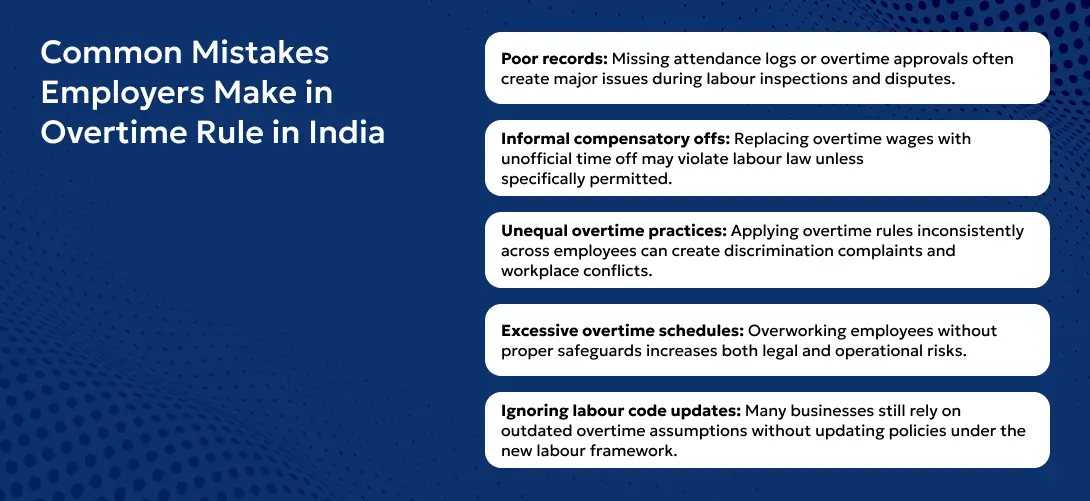
Ignoring overtime rule in India can expose businesses to legal, financial, and compliance risks.
Proper overtime compliance helps businesses avoid unnecessary legal disputes, financial liabilities, and operational risks.
Make sure overtime wages, attendance records, and employee policies are managed correctly.
Sometimes, real stories explain the law better than theory. A recent case in the Bombay High Court showed how important it is for companies to respect overtime rules in India.
Context:
Three retired employees from Maharashtra Electricity Distribution Company Limited (MSEDCL) had worked extra hours during their service. Their overtime was properly approved by their senior officers, but when they retired, the payment for those extra hours was not given.
The Issue:
The company argued that internal policies and retirement meant the workers could not claim overtime later. The workers, however, believed that since their overtime had been officially sanctioned, it was their legal right to be paid as per labour law for overtime in India.
The Trigger:
The employees took the matter to the labour court, demanding payment of around ₹6,12,900 as overtime wages, along with interest. They relied on their approval letters and the legal protections under the Factories Act.
The Impact:
The Bombay High Court sided with the workers. In the recent judgement, it clearly said that once overtime is sanctioned, it becomes a legal right of the employee. The court explained that no internal policy or retirement can cancel that right. The labour court’s order in favour of the workers was upheld, and the company was directed to pay them as per overtime payment rules in India.
Why It Happened:
The company misunderstood the law and believed its internal rules carried more weight than statutory rights. This mistake led to unnecessary litigation and financial loss.
What We Learn:
This case reminds us that overtime wages are not a favour from employers but an employee’s legal right. If extra work is approved, the payment must follow. Employers should always respect statutory provisions, and employees should know that their rights remain protected, even after retirement.
Managing overtime compliance has become more complex under the new labour codes and Social Security framework. Employers must now maintain accurate overtime calculations, compliant wage structures, and proper payroll documentation to avoid disputes and penalties.
We can help your business:
Whether you run a startup or a large organisation, Vishaal Consultancy Services helps simplify overtime compliance and workforce management.

Need help calculating overtime or updating your organisation’s working hours policies? Speak with our experts.
Overtime compliance today is no longer limited to paying employees for extra hours. Businesses must now manage proper documentation, digital compliance, wage transparency, and state-specific labour requirements while ensuring employees are treated fairly and legally.
At Vishaal Consultancy Services, we help businesses simplify overtime compliance through expert labour law advisory, payroll support, and statutory compliance solutions. If you want to reduce compliance risks and build a legally secure workforce system, connect with our experts today.
See Related Blogs
BLOGS
Fill in your details to download our New Labour Code PDF.
Fill in your details to download our exclusive e-learning document.
Fill in your details to download our exclusive e-learning document.
Fill in your details to download our exclusive e-learning document.