

Table of Content
Many employers still think gratuity is simple. If an employee completes 5 years, the company pays gratuity and closes the settlement. But in 2026, gratuity rules are becoming more confusing for many businesses. Fixed-term hiring, changing rules around continuous service, and stricter labour compliance checks are creating problems for HR teams.
Today, one employee may ask for gratuity after working 4 years and 240 days, while another fixed-term employee may become eligible without completing 5 years. Because of this, many companies are facing confusion during employee exits and final settlements.
In this blog, we’ll help you understand the new rules for gratuity in India, who qualifies, and what businesses should do in 2026 to avoid compliance mistakes and disputes.
| Topic | Key Rule |
|---|---|
| Governing law | Payment of Gratuity Act, 1972 |
| Applicability | Establishments with 10+ employees |
| Standard eligibility | 5 years continuous service |
| Fixed-term employees | Eligible under certain conditions |
| Payment timeline | Within 30 days |
| Maximum tax-exempt limit | ₹20 lakh |
Unsure whether an employee qualifies for gratuity or how the final amount should be calculated? Get expert assistance.
The law itself may not have changed drastically, but the way gratuity is interpreted and enforced certainly has. Employers are now expected to handle employee benefits with better documentation, stronger payroll systems, and clearer compliance processes.
Key changes and practical shifts include:
Companies hiring fixed-term employees now need to review gratuity eligibility carefully because gratuity may apply even without completing 5 years in certain cases. Many employers still assume it applies only to permanent employees, which leads to disputes later.
Employees today actively check labour laws, service records, and final settlements. As a result, incorrect gratuity calculations and benefit denials are being questioned more often.
Attendance records, salary slips, leave data, and employment timelines are now easier to verify digitally. Poor documentation can create compliance issues during audits or disputes.
Certain absences, like maternity leave, sick leave, and approved leaves may still count as continuous service. Employers can no longer assume that every absence breaks eligibility.
Gratuity is now treated as a serious statutory obligation. Delays, wrong calculations, or denial of gratuity can lead to penalties and legal disputes.
Gratuity is a statutory financial benefit paid by an employer to an employee for long and continuous service. It is governed under the Payment of Gratuity Act, 1972.
Many people confuse gratuity with bonus, PF, or leave encashment. But gratuity is different. It is specifically linked to service duration and employment continuity.
The law generally applies to:
For example, if an employee works continuously in an organisation for several years and then resigns, retires, or leaves the company under eligible conditions, gratuity may become payable.
And yes, this applies across many sectors in India, not just corporate offices.

Avoid gratuity calculation errors and settlement disputes with proper compliance guidance.
In cases involving death, disability, or serious illness, gratuity may become payable even before completing 5 years. These situations are treated differently under the law to protect employees and their families.
Now let’s see who doesn’t qualify for gratuity.
Employees leaving before completing the required continuous service period may not qualify for gratuity under standard rules. Major interruptions affecting continuity can also impact eligibility.
Genuine freelancers and consultants are usually not covered under gratuity provisions. However, incorrect employee classification can create legal complications for employers later.
Gratuity may be partially or fully forfeited in cases involving fraud, theft, violent conduct, or moral turpitude. Still, employers must follow proper disciplinary procedures before denying gratuity benefits.
Need clarity on gratuity eligibility, continuous service or final settlement obligations? Our experts can help.
Continuous service is one of the most misunderstood parts of gratuity rules 2026. Many employers assume every leave or absence breaks service continuity, but that is not always correct.
The following periods may still count as continuous service:
For example, if an employee works for 4 years and 240 days while also taking approved paid leave during that period, those leave days may still count toward the continuous service calculation.
This is exactly why proper attendance records, payroll documentation, and leave tracking systems are important. A small calculation mistake can easily turn into a legal dispute during final settlement.
Now, coming to the part that most employees and HR teams search for. The gratuity calculation itself isn’t very difficult once the eligibility is clear.
The standard gratuity formula is:
Gratuity = (Last Drawn Salary × 15 × Years of Service) / 26
Here:
For example:
In this case:
(45,000 × 15 × 8) ÷ 26
The gratuity amount would come to approximately ₹2,07,692.
Of course, exact calculations can vary depending on salary structure and employment records. So, companies should always verify calculations properly before settlement.
Review your gratuity processes before an incorrect calculation becomes a compliance or employee dispute
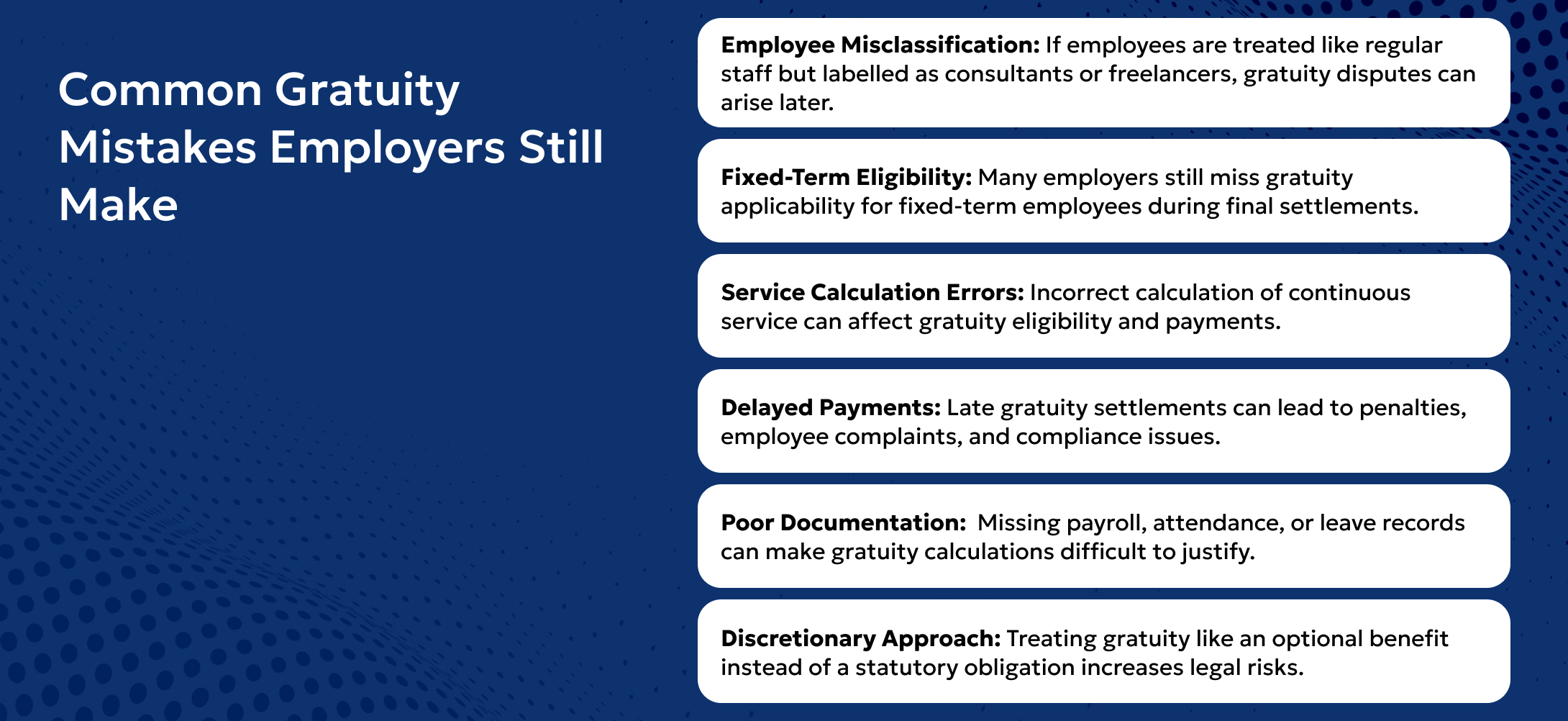
Accurate payroll, attendance, and leave records help employers calculate gratuity correctly and handle disputes more confidently.
Businesses using fixed-term or project-based hiring should regularly review contracts for gratuity applicability.
A structured full-and-final settlement process helps reduce delays, calculation mistakes, and compliance issues during employee exits.
Companies should regularly check whether consultants or freelancers legally qualify as employees under labour laws.
HR and payroll teams should stay updated on gratuity rules, continuous service interpretation, and settlement requirements.
Incident:
Violations:
Outcome:
At Vishaal Consultancy Services, we regularly help businesses handle gratuity compliance, employee classification reviews, payroll documentation, and labour law obligations with more clarity and confidence.
If your organisation is unsure about gratuity eligibility, final settlement calculations, or compliance processes, our team can help you reduce legal risks and stay aligned with current labour law requirements.
The new rules for gratuity in India are making gratuity compliance more detailed for employers. From fixed-term employee eligibility to continuous service calculations, businesses can no longer rely on outdated assumptions or weak HR processes while handling employee settlements.
Strengthening gratuity compliance now can help organisations avoid disputes, penalties, and settlement errors later. If your business needs support with gratuity rules 2026, labour law compliance, payroll documentation, or employee benefit processes, Vishaal Consultancy Services can help you stay compliant and manage statutory obligations more confidently. Contact us today.
Make gratuity calculations and employee settlements easier for your HR and payroll teams.
See Related Blogs
BLOGS
Fill in your details to download our New Labour Code PDF.
Fill in your details to download our exclusive e-learning document.
Fill in your details to download our exclusive e-learning document.
Fill in your details to download our exclusive e-learning document.