

Table of Content
A minimum wage revision can easily slip through a busy payroll cycle. But if your business continues using outdated rates, even a routine salary calculation can result in underpayment, payroll discrepancies and avoidable compliance issues. This becomes harder to manage when employees work across different locations or fall under different skill categories.
The Maharashtra minimum wages 2026 rates are now applicable from 1 July 2026 to 31 December 2026. The amount you need to pay depends on factors such as the employee’s skill category and the zone of the establishment. The revised Variable Dearness Allowance (VDA) also needs to be considered when reviewing your wage structure
and payroll records.
| Skill category | Zone I | Zone II | Zone III |
|---|---|---|---|
| Unskilled | ₹14,155 | ₹13,559 | ₹12,962 |
| Semi-skilled | ₹14,990 | ₹14,394 | ₹13,798 |
| Skilled | ₹15,766 | ₹15,170 | ₹14,574 |
| Factor | What the employer needs to check | Why it matters |
|---|---|---|
| Scheduled employment | The wage notification applicable to the establishment | Different scheduled employments may have different rates |
| Geographical zone | Zone I, Zone II or Zone III | The minimum wage varies by zone |
| Skill category | Unskilled, semi-skilled or skilled | Each category has a different minimum |
| Wage components | Basic, VDA and applicable HRA | The applicable wage structure needs to be considered |
| Effective date | The period covered by the wage notification | The current revised rates apply from 1 July 2026 |
The applicable minimum wage depends on the location of the establishment. Maharashtra classifies locations into Zone I, Zone II, and Zone III.
| Zone | Areas covered |
|---|---|
| Zone I | Municipal Corporation areas, cantonment areas and specified industrial areas within 20 km of Municipal Corporation limits |
| Zone II | Areas within A and B grade Municipal Councils |
| Zone III | All other areas not covered under Zone I or Zone II |
The difference affects the minimum wage. For example, the Basic + VDA minimum for an unskilled employee under the relevant schedule is ₹14,155 in Zone I and ₹12,962 in Zone III.
Businesses with establishments in different locations should check out the applicable zone for each establishment before applying the minimum wage rate.
Avoid underpayment and payroll compliance gaps by checking the correct wage rate for each employee’s zone and skill category.
Variable Dearness Allowance (VDA) is the cost-of-living component of the statutory minimum wage. For July to December 2026, the VDA under the relevant schedule is ₹4,134 per month.
The VDA is added to the prescribed basic wage when determining the applicable minimum Basic + VDA. For example, for a semi-skilled employee in Zone I:
| Wage component | Amount |
|---|---|
| Basic wage | ₹10,856 |
| VDA | ₹4,134 |
| Basic + VDA | ₹14,990 |
For establishments employing more than 50 workers, the applicable notification also provides HRA at 5% of Basic + VDA, subject to the conditions specified in the notification.
Payroll teams should therefore check the basic wage, VDA, and any applicable HRA separately rather than comparing only the employee’s gross salary with the minimum wage.
Need help applying the revised Maharashtra minimum wages correctly across your workforce?

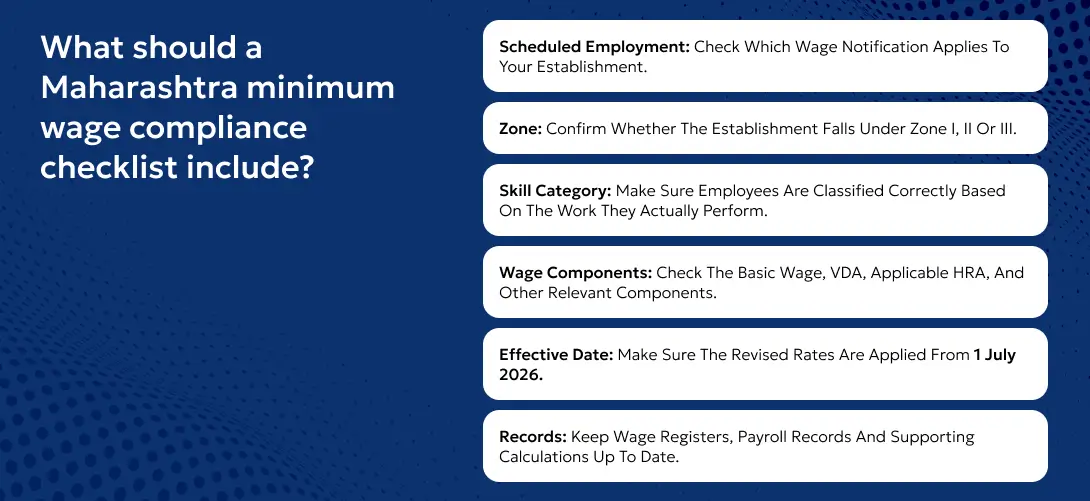
Consider a semi-skilled employee working at a Zone I establishment covered by the relevant schedule. For July to December 2026:
Basic wage: ₹10,856
VDA: ₹4,134
Basic + VDA: ₹14,990
If the employee’s gross salary is ₹15,500, that alone doesn’t confirm compliance. The employer still needs to check the employee’s skill classification, wage components, and any applicable statutory provisions.
So, payroll compliance shouldn’t be checked by comparing gross salary with the minimum wage alone. The underlying wage structure
also needs to be reviewed.

For Maharashtra employers, minimum wage compliance goes beyond updating a salary figure. The right rate depends on the scheduled employment, location, skill category, and applicable wage components. You can catch payroll gaps early by reviewing these details against the July–December 2026 rates and correcting any outdated calculations.
If you need help reviewing your Maharashtra minimum wages 2026 requirements, employee classifications or payroll records, Vishaal Consultancy Services can help. Book your free consultation call, today.
Managing employees across different Maharashtra locations or skill categories? Get expert help applying the correct minimum wage rates.
The EPFO wage ceiling has been revised from ₹15,000 to ₹25,000 per month, effective from 17 September 2026 under Gazette Notification S.O. 5109(E).
The revised ceiling applies from 17 September 2026. The shared FAQ states that for September 2026, ₹15,000 applies up to 16 September and ₹25,000 from 17 September onwards.
Yes. According to the FAQ, a first-time employee with applicable wages up to ₹25,000 comes under mandatory EPF and EPS coverage.
Employees previously excluded under the old ₹15,000 ceiling may now become coverable if their applicable wages are ₹25,000 or less, effective from 17 September 2026.
| Source | What It Confirms | Date | Reference Link |
|---|---|---|---|
| Ministry of Labour & Employment – Gazette Notification S.O. 5109(E) | Official notification increasing the EPFO wage ceiling from ₹15,000 to ₹25,000 per month; Gazette ID CG-DL-E-17092026-276299 | 17 September 2026 | View Gazette Notification PDF |
| Prime Minister of India – Cabinet Approval | Confirms Cabinet approval to increase the mandatory EPFO wage ceiling from ₹15,000 to ₹25,000 and states that more than 51 lakh additional employees are expected to come under coverage | 16 September 2026 | View PM India Announcement |
| Press Information Bureau – Ministry of Labour & Employment | Confirms the increase from ₹15,000 to ₹25,000, the affected ₹15,000–₹25,000 wage group and estimated coverage of more than 51 lakh additional employees | 17 September 2026 | View PIB Announcement |
| Press Information Bureau – Govt Hikes EPFO Wage Ceiling to ₹25,000 | Confirms that employees earning between ₹15,000 and ₹25,000 will come within the expanded social-security framework, subject to applicable scheme rules | 18 September 2026 | View PIB Employer Update |
| Press Information Bureau – Cabinet Raises EPF Wage Ceiling | Confirms the revised ₹25,000 ceiling and states that the new ceiling is effective from 17 September 2026 | 17 September 2026 | View PIB Effective-Date Update |
See Related Blogs
BLOGS
BLOGS
BLOGS
Fill in your details to download our New Labour Code PDF.
Fill in your details to download our exclusive e-learning document.
Fill in your details to download our exclusive e-learning document.
Fill in your details to download our exclusive e-learning document.