
Table of Content
The new PF withdrawal rules give you more ways to take money out of your PF account. On 19 November 2026, the EPFO board approved three changes. You will be able to get your PF as a monthly payout after you retire. You can take out more of your PF before retirement. And you only must wait 2 months after losing a job to close your PF account.
This guide explains each change in simple words. It covers what it means for employees, when it starts, and what HR and payroll teams need to get ready for.
Quick answer
The EPFO’s Central Board of Trustees (CBT) is the top body that makes decisions about your PF. At its 240th meeting in New Delhi on 19 November 2026, chaired by Labour Minister Dr Mansukh Mandaviya, it approved three changes:
| What changed | Before | After |
|---|---|---|
| How you get PF at retirement | One lump sum | Lump sum, or payments over time (SWP) |
| Minimum balance you must keep (partial withdrawal) | 25% | 10%, so you can take out up to 90% |
| Wait before full withdrawal after job loss | 12 months | 2 months |
These build on the EPF changes from earlier in 2026, such as the new EPF Scheme 2026 and the ₹25,000 wage ceiling. For the full list of those changes, see our guide to EPF changes earlier in 2026.
Need help understanding what EPFO’s new SWP option could mean for your employees?
EPFO SWP lets you take your PF money in regular payments after you retire, a bit like a salary, instead of all at once. Until now, most people withdrew everything on retirement and then had to decide where to keep it.
With the SWP, you choose how you want to be paid:
The money still in your PF account keeps earning EPF interest. The current rate is 8.25% a year.
If the member dies: the nominee or family can either take the remaining balance or keep receiving the payments.
Say you retire with ₹50 lakh in PF. Media reports quoting EPFO’s own estimates say this could give about ₹41,822 a month, assuming an 8% return. By comparison, the same money could give about ₹32,492 a month from a bank FD, or ₹30,637 from an annuity. Your actual amount will depend on the interest rate, how long you choose, and the final rules.
SWP is meant for members who are retiring. EPFO estimates around 6.32 lakh members above 55 could benefit. In the first phase it covers members whose PF is managed directly by EPFO. Companies that run their own exempted PF trusts are not covered yet.
Not sure how your PF builds up in the first place? Read how PF contribution works.

You can withdraw up to 90% of your eligible PF balance while you are still working. Before this, you had to leave 25% in the account, so the most you could take out was 75%.
Example: your eligible PF balance is ₹5,00,000.
You still need a valid reason. Since October 2025, EPFO has grouped the reasons into three types: essential needs (illness, education, marriage), housing, and special circumstances.
One thing to remember: every rupee you take out now is a rupee that won’t grow for retirement. The 10% minimum balance is there to protect your future savings.
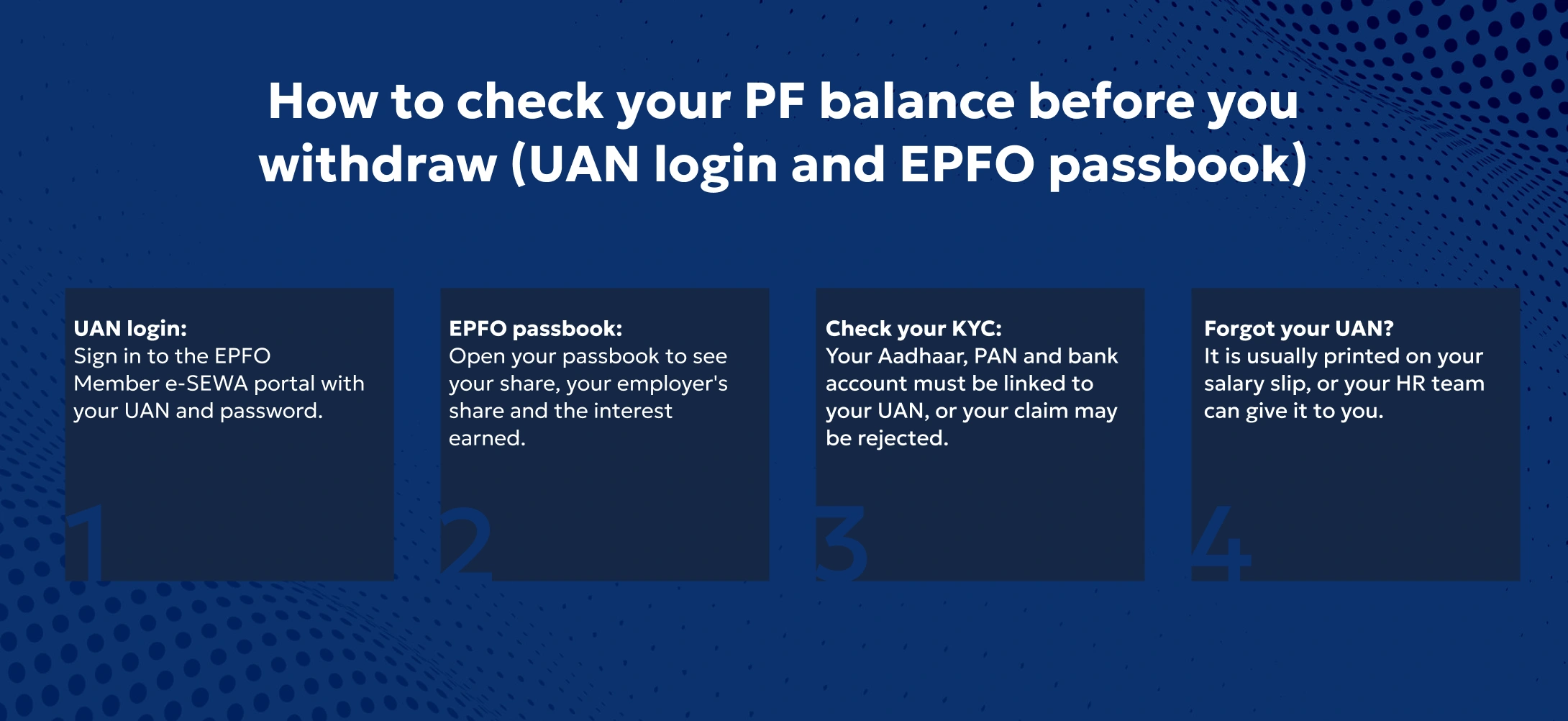
Tip: to withdraw online, your UAN must be active and linked to Aadhaar and your bank account. Your UAN stays the same when you change jobs.
Get your HR team ready to answer questions about the proposed PF withdrawal changes.
Check your balance first so you know what 90% works out to for you.
If you lose your job, you can withdraw your full PF after 2 months without work. In October 2025, EPFO had raised this wait to 12 months. The new decision brings it back to 2 months.
This helps people who need money between jobs. The pension (EPS) part works differently: you still need to be out of work for 36 months before you can make a final withdrawal of your pension money.
PF is only one part of what you get when you leave a job. Your full and final settlement can also include unpaid salary, leave encashment and gratuity. If you resigned, check how your notice period affects the final amount.
Not yet. The board has approved the changes, but they only become law once they are officially notified. The Labour Ministry has to amend the EPF Scheme, 2026, and the Department of Legal Affairs has to check it. Reports expect the SWP to start in about 2 months.
Until EPFO publishes the notification, the old rules still apply. A claim filed today will be processed under the 75% limit.
This hasn’t been decided yet. EPFO still has to work out with the Finance Ministry whether instalment payments, and the interest on the money left in the account, will be taxed the same way as a lump-sum withdrawal. Wait for the final rules before you plan your retirement income around SWP.
Your PF account has two parts: EPF (your savings) and EPS (your pension). The new rules change only the EPF part. The pension rules stay the same:
No, not as of 20 November 2026. Before the meeting, there were many reports that the board might raise the minimum EPS pension from ₹1,000 to ₹3,000 a month. Coverage after the meeting reports no decision on it. The minimum has stayed at ₹1,000 a month since 2014.
Need help with PF withdrawals, employee exits or final settlements?
Employees will ask HR about these changes before EPFO’s own portal is updated. Four things will save you trouble later:
These changes add to the bigger compliance work under the Code on Social Security. For your other duties, see our guide to Provident Fund rules for employers.

Need help preparing for EPFO’s PF withdrawal changes? Vishaal Consultancy Services helps businesses review employee exit processes, manage final settlements and respond to employee questions. Get support with PF, ESI and Professional Tax compliance and payroll processing.
Get help managing PF filings, employee records and payroll compliance.
See Related Blogs
BLOGS
BLOGS
Fill in your details to download our New Labour Code PDF.
Fill in your details to download our exclusive e-learning document.
Fill in your details to download our exclusive e-learning document.
Fill in your details to download our exclusive e-learning document.