

Table of Content
If you’re an employee, hearing about new EPF rules can immediately make you wonder: will your PF deduction change? For employers, the concern goes further, with payroll calculations, employee records and compliance processes all potentially affected.
The EPFO new rules 2026 introduce a new statutory framework along with several administrative and compliance changes. But this doesn’t mean every existing EPF provision has changed. Some claims about PF deductions, withdrawals, and benefits can also be misleading.
So, what has actually changed, and what does it mean for your salary, PF account, or business? Let’s look at the important updates and what you need to check.
The Employees’ Provident Funds Scheme, 2026, is a key part of the updated EPF framework under the Code on Social Security, 2020. The government notified the scheme on 29 June 2026, replacing the earlier Employees’ Provident Funds Scheme, 1952 under the new framework.
The government has also notified the Employees’ Pension Scheme, 2026 and the Employees’ Deposit Linked Insurance Scheme, 2026. Together, these schemes cover provident fund, pension and deposit-linked insurance benefits.
For employees, this doesn’t mean that all PF rules have changed. Employers, especially those managing exempted PF trusts, need to pay closer attention to the updated compliance requirements.
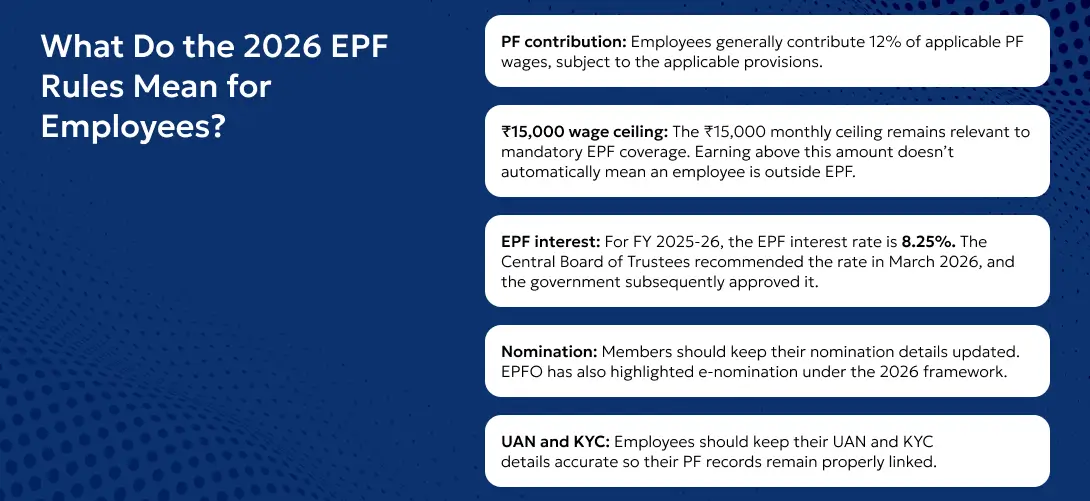
The EPFO new rules 2026 don’t require employees to change everything about how they manage their PF accounts. The practical points are mainly around contributions, interest, records, and access to PF benefits.
These points cover most of what an employee is likely to notice. The 2026 reforms also introduce operational changes that are more relevant to EPFO services and employer compliance.
The EPFO latest update also includes measures aimed at making EPF services and exemption processes easier to manage.
These measures focus on improving how members and employers manage existing PF accounts and exemption-related matters.
Avoid PF contribution errors, missed filings and employee record issues with professional EPFO compliance assistance.
The EPFO new policy requires employers to keep payroll, employee records and EPF compliance processes accurate. A proper review should cover both monthly contributions and records supporting those contributions.
Employers should review:
Employers with exempted PF trusts need to pay particular attention to their exemption of documents and compliance history. EPFO has introduced measures that affect the administration of exempted establishments, including a simplified process for exemption-related matters.
It’s also worth reconciling payroll records with the amounts actually deposited. If the two don’t match, the employer should identify the reason and correct the records where required.
The EPFO Amnesty Scheme 2026 gives certain establishments with PF trusts a chance to fix exemption-related issues and bring their records up to date, subject to the scheme’s conditions.
It applies to establishments whose PF trusts have recognition under the Income Tax Act, 1961 but don’t have the required formal EPF exemption notification. The scheme was notified on 29 June 2026 and is available for six months.
Eligible establishments can apply for retrospective regularisation and either comply with unexempted establishments or, where allowed, continue as exempted establishments under the applicable framework. They must also meet the required application, audit, and other conditions.
If your organisation operates an exempted PF trust, check its exemption status and records to see whether the scheme applies and what steps you need to take.

Need help updating your PF processes according to the latest EPFO rules and contribution requirements?
The EPFO latest update makes accurate PF records important for both employees and employers. A regular review can help identify contribution or record errors early.
Employees should:
Employers should:
These checks give employees and employers a practical way to identify discrepancies and address them without allowing small record or payroll issues to build up.
The epf new rules 2026 introduce an updated framework, but they don’t replace every provision that employees and employers have been following. This distinction matters because not every claim about a “new PF rule” online reflects an actual change in the law.
Some important provisions continue to apply:
So, the introduction of the 2026 schemes doesn’t automatically mean that your PF deduction, account, or withdrawal rights have completely changed. Employers should apply the rules relevant to their establishment, while employees should check their actual PF records before acting on information shared online.

The EPFO new rules 2026 bring EPF, pension and insurance benefits under the updated 2026 schemes, while several familiar employee provisions continue to apply. The key developments include the new statutory framework, the 8.25% EPF interest rate for FY 2025-26, operational changes, and new measures for eligible PF trusts.
For employers, reviewing payroll, EPF records, statutory payments and PF trust documentation is essential under the updated framework. Vishaal Consultancy Services can help you understand the EPFO new rules 2026, identify compliance gaps and manage your EPF and labour-law requirements with confidence.
Keep your organisation prepared for EPFO changes with reliable support for registration, contributions and ongoing compliance.
See Related Blogs
BLOGS
Fill in your details to download our New Labour Code PDF.
Fill in your details to download our exclusive e-learning document.
Fill in your details to download our exclusive e-learning document.
Fill in your details to download our exclusive e-learning document.