

Last Updated: 10 September 2026
Reviewed By: R. Vasudeva, Founder & CEO, Vishaal Consultancy Services – MSW (Personnel Management & Labour Legislation), LLB. 25+ years in HR and labour law compliance, including a decade in corporate HR at BPL Limited before founding VCS in 2001.
This article has been reviewed against publicly available developments relating to the Karnataka minimum wage notification dated 22 May 2026, the pending High Court proceedings and the State Government’s review.
Subsequent court orders or government notifications may change the position, so employers should verify the latest requirements applicable to their establishment.
Table of Content
The enhancement of Karnataka minimum wages 2026 has emerged as one of the most significant labor law developments of 2026. While the Karnataka Government’s revised minimum wage framework has already come into force, its implementation continues to face legal scrutiny before the Karnataka High Court following challenges filed by various industry associations.
The dispute has generated considerable attention among employers, HR professionals, labor law practitioners, trade unions, and businesses across sectors. Industry bodies argue that the revised wage rates impose a substantial financial burden on businesses, particularly micro, small and medium enterprises (MSMEs), whereas trade unions maintain that the revision is both legally mandated and necessary to ensure workers receive wages that reflect present-day living costs.
As of August 2026, the matter remains pending before the Karnataka High Court. Importantly, despite the legal challenge, no interim stay has been granted against the revised minimum wage notification. Consequently, employers are expected to comply with the notified wage rates unless directed otherwise by the Court.

The Karnataka minimum wage revision announced in May 2026 continues to remain an important compliance issue for employers across the state. The notification has been challenged before the Karnataka High Court, while the State Government has separately initiated a review of the revised wage framework.
| Development | Current Status |
|---|---|
| Revised minimum wage notification | Issued on 22 May 2026 |
| Coverage | 81 scheduled employments |
| High Court challenge | Pending |
| Karnataka Employers’ Association case | W.P. No. 16145/2026 |
| Interim stay on the May 2026 notification | No interim stay identified as of 10 September 2026 |
| Government review | Cabinet Sub-Committee constituted |
| Purpose of government review | To examine the May 2026 notification in relation to the Code on Wages, 2019 |
The court proceedings and the State Government’s review are two separate developments. The constitution of a review committee does not, by itself, amount to a stay or cancellation of the minimum wage notification.
As of September 2026, the Karnataka High Court continues to hear challenges to the revised minimum wage notification.
Employer associations have questioned the legal basis, methodology and financial impact of the revision. The Karnataka Government has also constituted a Cabinet Sub-Committee to review the May 2026 notification in relation to the Code on Wages, 2019.
No final judgment on the validity of the notification has been identified as of this update.
The revision of minimum wages in Karnataka is the culmination of a lengthy regulatory process. Although the State initiated a wage revision exercise during 2022-23, the proposals at that stage were challenged by labor unions, who argued that the methodology adopted failed to adequately follow the principles laid down by the Supreme Court for fixation of minimum wages.
Following judicial intervention, the State Government undertook a fresh exercise involving:
Subsequently, the Labor Department issued the final notification on 22 May 2026 covering 81 scheduled employments across Karnataka.
Rather than maintaining separate wage structures for each scheduled employment, the State introduced a more standardized framework based on geographical zones and employee skill categories. The objective was to simplify wage administration while ensuring more uniform wage protection across industries.
Although the notification came into immediate effect, its implementation has since become the subject of ongoing litigation before the Karnataka High Court.
Several employer organizations, including the Karnataka Employers’ Association (KEA), builders’ associations, hotel and hospitality associations, resident welfare organizations, and other sectoral bodies, have approached the Karnataka High Court challenging the revised notification.
According to industry representatives, the revised wages represent an unprecedented increase that significantly exceeds historical revisions. Their principal arguments include:
Industry bodies contend that after accounting for annual Variable Dearness Allowance (VDA) revisions, quinquennial wage revisions have historically resulted in increases of approximately 10–15%.
They argue that the present revision effectively increases wage costs by nearly 60%, making it economically unsustainable for employers.
Employers submit that businesses are already dealing with increasing operational expenses, inflationary pressures, rising compliance costs, and uncertain global economic conditions, including disruptions arising from geopolitical tensions in West Asia.
According to employer associations, the revised wages significantly increase labor costs, particularly for labor-intensive sectors such as:
Industry representatives argue that such a substantial increase may adversely affect business viability and employment generation.
Another significant ground raised before the High Court relates to the methodology adopted while fixing wages. Employer associations have alleged that the calculations are arbitrary, disproportionate, and not supported by sound economic principles.
They further contend that Karnataka already has one of the highest minimum wage structures in India and that the revised framework places employers at a competitive disadvantage compared to neighboring states.
The Karnataka minimum wage notification dated 22 May 2026 has been challenged before the Karnataka High Court.
One of the principal matters is Karnataka Employers’ Association & Anr. v. State of Karnataka & Ors., W.P. No. 16145/2026.
The petitioners have raised concerns about the legal framework used for the revision, the methodology adopted and the extent of the wage increase.
As of September 2026, the case remains pending and no final judgment has been identified.
A common question among employers is whether the Karnataka High Court has stayed the revised minimum wages notified on 22 May 2026.
At the time of this update , no interim stay against the May 2026 minimum wage notification has been identified.
A pending court case or government review does not automatically suspend a notification.
Employers should therefore rely on the latest applicable court order, Labour Department notification or government clarification before changing their wage-compliance position.
The Karnataka minimum wage position may develop further through either the pending court proceedings or the State Government’s review.
Employers should particularly monitor:
Until an official development changes the position, employers should maintain accurate wage and payroll records and be prepared to respond quickly to any new court or government direction.
Trade unions have strongly opposed the industry’s objections and have defended the revised wage notification.
Representatives of the All-India Trade Union Congress (AITUC) maintain that the revision was overdue and legally necessary. According to the unions:
Trade unions further argue that minimum wages are calculated based on the actual cost of meeting essential needs of a worker’s family, including food, healthcare, housing, and other basic living expenses.
Accordingly, they maintain that periodic revision is essential to protect workers against inflation and preserve their purchasing power.
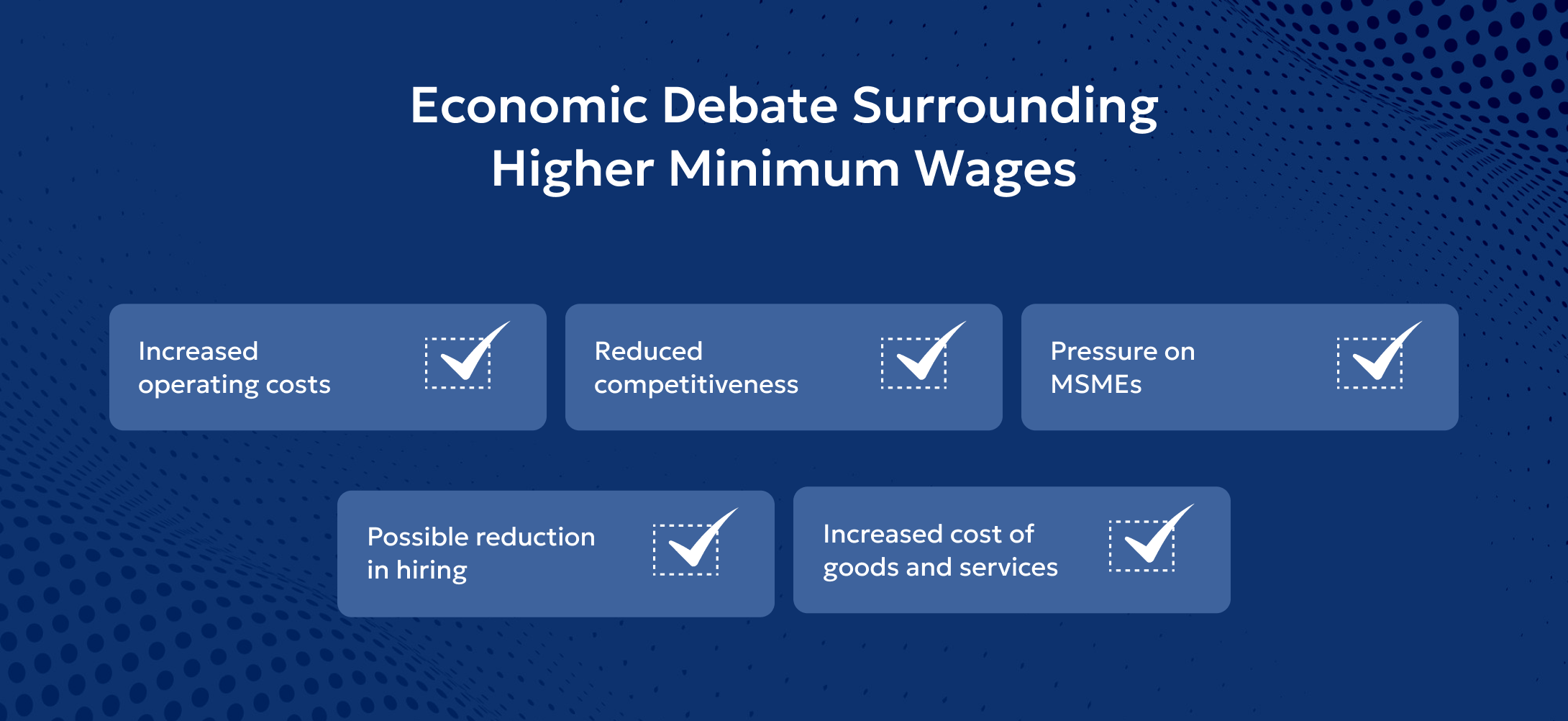
The ongoing litigation has also revived the broader economic debate concerning minimum wage policy. Industry representatives argue that higher wage obligations may lead to:
Conversely, labor unions argue that higher wages improve household purchasing power, increase consumer demand, stimulate economic activity, and ultimately contribute to overall economic growth.
According to union representatives, improved worker incomes can strengthen domestic consumption, which in turn benefits businesses across multiple sectors.
The present litigation is not the first time Karnataka’s minimum wage revision has been challenged.
During the 2016-17 wage revision, employer associations had similarly approached the Karnataka High Court after the Government notified an increase exceeding 70%.
The High Court ultimately upheld the revised wages, observing that minimum wages cannot remain static and must evolve with changing economic realities.
The Court also held that wage fixation in Karnataka cannot be determined solely by comparing wage rates prevailing in neighboring States.
This earlier judgment has become an important point of reference in the current proceedings, although the present challenge will be decided based on the facts, methodology, and legal issues involved in the 2026 notification.
As of August 2026, writ petitions challenging the revised minimum wages remain pending before the Karnataka High Court.
The Karnataka Employers’ Association has already instituted proceedings questioning the legality of the revised notification. However, the Court has not granted any interim stay on the operation of the revised wage notification. Accordingly:
Businesses should therefore closely monitor further developments while ensuring ongoing compliance with applicable wage laws.
Pending the High Court’s final decision, employers operating in Karnataka should continue reviewing their compliance obligations. Key areas requiring attention include:
Employers engaging in contract labor should also ensure that contractors comply with the revised wage requirements, as principal employers may face statutory liability for non-compliance.

The Karnataka minimum wage litigation is likely to have far-reaching implications for labor regulation in the State.
The High Court’s decision will not only determine the legality of the present notification but may also provide further judicial guidance regarding the methodology for fixation of minimum wages under India’s evolving labor law framework, including the transition under the Code on Wages, 2019.
For businesses, the case highlights the importance of balancing statutory compliance with workforce cost management. For employees and trade unions, it represents an important step towards ensuring wages remain aligned with changing economic conditions and the cost of living.
Until the Court delivers its final judgment, employers should continue to comply with the existing notification while staying informed about further judicial developments.
The enhancement of minimum wages in Karnataka remains one of the most closely watched labor law issues in 2026. While industry bodies have questioned the scale of the increase and challenged the notification before the Karnataka High Court, trade unions continue to defend the revision as a legally mandated measure designed to protect workers’ livelihoods.
At present, the revised minimum wage notification remains fully operational since no interim stay has been granted by the High Court. Employers should therefore ensure compliance with the notified wage structure while monitoring the progress of pending litigation.
If your organization requires assistance with Karnataka with minimum wage compliance, labor law advisory, payroll structuring, contractor compliance, or other employment law obligations, Vishaal Consultancy Services is here to support you.
Get in touch with us today to ensure your organization remains compliant with Karnataka’s latest labor law requirements.
The revised minimum wage notification issued by the Karnataka Government is currently under consideration before the Karnataka High Court. As per the current position, employers need not comply with the revised minimum wage rates until the court hearing scheduled in August 2026. Further clarity is expected based on the proceedings and directions of the Court.
Industry bodies have challenged the notification, arguing that the wage increase is excessive, economically burdensome, and based on an arbitrary methodology that significantly increases labor costs for businesses.
As per the current position, employers need not implement the revised minimum wage rates until the Karnataka High Court hearing scheduled in August 2026. Businesses should continue monitoring the proceedings and any subsequent directions or orders issued by the Court.
While employers need not implement the revised rates until the scheduled court hearing in August 2026, businesses should remain prepared by reviewing employee wage structures, skill and zone classifications, payroll systems, contractor arrangements, and statutory records. Any implementation should be undertaken in accordance with the subsequent directions or orders of the Karnataka High Court.
| Source | What It Supports | Reference |
|---|---|---|
| Karnataka e-Gazette | Official publication of the Karnataka minimum wage notification and related government notifications | Official e-Gazette Portal |
| High Court of Karnataka | Current case status, hearing progress and orders in the minimum wage litigation | Official Case Status Portal |
| Karnataka Employers’ Association – Circular 032/2026 | Confirms KEA’s challenge to the 22 May 2026 minimum wage notification and W.P. No. 16145/2026 | View Circular |
| Karnataka Employers’ Association – Circular 057/2026 | Supports the government review / Cabinet Sub-Committee update relating to the May 2026 notification | View Circular |
See Related Blogs
BLOGS
Fill in your details to download our New Labour Code PDF.
Fill in your details to download our exclusive e-learning document.
Fill in your details to download our exclusive e-learning document.
Fill in your details to download our exclusive e-learning document.