

Table of Content
Starting a business means meeting legal responsibilities from the very beginning. While registrations like GST and company incorporation often receive immediate attention, many employers overlook Shops and Establishment Registration, one of the earliest labour law compliances applicable to commercial establishments.
Missing this registration can lead to compliance notices, delays in obtaining licences, and unnecessary legal complications. Understanding whether your business requires registration helps you stay compliant from the start and avoid issues as your business grows.
In this blog, we’ll explains what Shops and Establishment Registration is, who needs it, when to apply, the registration process, your responsibilities after registration, and how it supports long-term labour law compliance.
The Shops and Establishments Act is a state-specific labour law that regulates employment conditions in shops, commercial establishments, and service businesses. Each state has its own Act, but all aim to regulate matters such as working hours, leave, employee records, and workplace conditions.
Shops and Establishment Registration is the process of registering your business under the applicable state Act. Once registered, your business is recognised under state labour laws and must comply with the provisions prescribed by the respective labour department.
Most commercial establishments employing people are required to register under the applicable Shops and Establishments Act, subject to their state’s rules.
This generally includes:
The requirement isn’t limited to large organisations. Depending on your state’s laws, even a small office or newly established business may need to register soon after commencing operations.
You should apply for Shops and Establishment Registration soon after your business commences operations, within the timeline prescribed by your state’s Shops and Establishments Act. Applying on time helps you avoid penalties, compliance issues, and delays in obtaining other business approvals.
Registering under the Shops and Establishments Act does more than fulfil a legal requirement. It helps you operate your business with greater confidence while supporting ongoing labour law compliance.
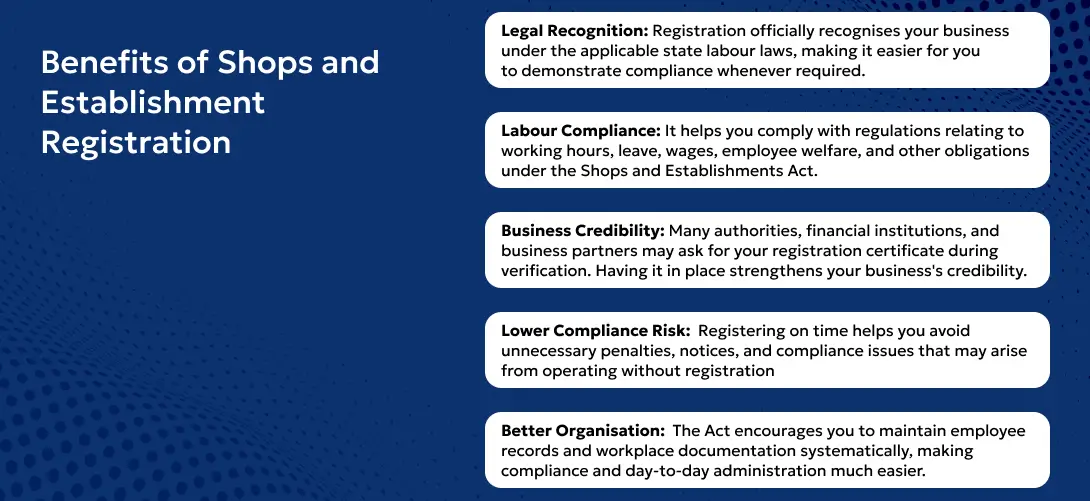
Preparing your documents before applying helps make the registration process quicker and reduces the chances of delays during verification. While the exact requirements vary across states, employers are generally required to submit the following:
Some states may request additional documents depending on the type of establishment or employee strength.

Most state labour departments now offer online registration, making the process simpler for employers. Although the procedure may vary slightly across states, the overall process remains similar.
After obtaining your registration certificate, you should continue complying with the applicable provisions of the Shops and Establishments Act by:
Many employers assume GST registration covers all legal requirements for running a business. However, these registrations serve different purposes.
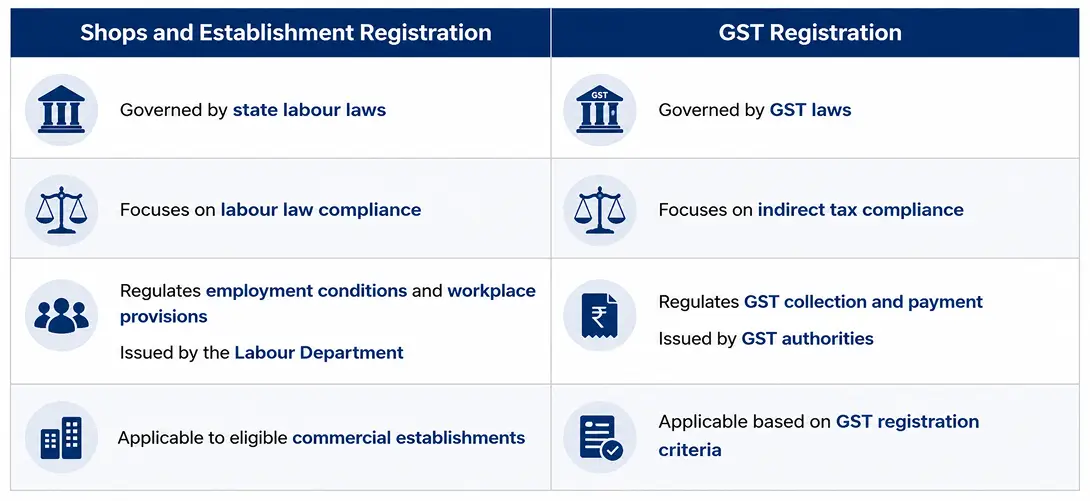
Depending on your business activities, you may require both registrations. One ensures labour law compliance, while the other fulfils your tax obligations.
Labour law compliance differs across states, making the registration process more complicated than many employers expect. Vishaal Consultancy Services helps you complete your registration accurately while ensuring your business remains compliant with applicable labour laws.
We can assist you with:
Completing Shops and Establishment Registration at the right time helps you avoid compliance issues and build a stronger legal foundation for your business. Staying compliant from the beginning also makes it easier to manage your responsibilities as an employer as your organisation grows.
If you need guidance with Shops and Establishment Registration or broader labour law compliance, Vishaal Consultancy Services is here to help. Our experts provide practical advice and end-to-end support, book your consultation today.
Not always. Whether you need to register depends on your state’s Shops and Establishments Act and the nature of your business. If you’re unsure about the applicability, checking the requirements before starting operations can help you avoid future compliance issues.
Yes. Most state labour departments now offer online registration portals where you can submit applications, upload documents, pay the registration fee, and receive your certificate. If you’d like expert guidance, you can also book a consultation with Vishaal Consultancy Services.
You’ll generally need your identity proof, PAN card, business address proof, ownership or rental documents, a recent utility bill, photographs, and business registration documents where applicable. Keeping these documents ready beforehand helps you complete the registration process more efficiently.
See Related Blogs
BLOGS
BLOGS
Fill in your details to download our New Labour Code PDF.
Fill in your details to download our exclusive e-learning document.
Fill in your details to download our exclusive e-learning document.
Fill in your details to download our exclusive e-learning document.