

Table of Content
Are you finding it harder to keep track of payroll, PF, and ESI every month without missing something?
Managing payroll today involves more than just calculating salaries and sending payments. It also includes PF, ESI, tax deductions, and staying updated with changing labour rules. Each part needs attention, and keeping everything aligned month after month takes effort and consistency.
Many businesses handle these processes manually, which means tracking timelines, calculations, and records at the same time. Without a clear system, it can start to feel scattered, especially as your team grows or compliance requirements increase.
In this blog, we will walk you through a practical HR Compliance Checklist, along with key areas in payroll, PF, and ESI that you need to manage for smooth and consistent compliance.
HR compliance in payroll means handling employee salaries in a way that follows all legal rules. This includes paying the correct wages, deducting PF and ESI properly, filing required returns on time, and keeping records updated. It also covers areas like TDS deductions, minimum wage compliance, and maintaining statutory registers.
In simple terms, it is about making sure your payroll process is accurate, timely, and legally correct every month. When done properly, it helps you avoid penalties and keeps both your business and employees protected.
The new labour codes mainly change how “wages” are calculated, and this directly affects your payroll. Earlier, companies could keep the basic salary lower and give more allowances. Now, the rules limit how much of the salary can be shown as allowances, so the basic component often increases.
Since PF is calculated on basic wages, a higher basic means higher PF contributions for both the employer and the employee. This also changes the overall salary structure and monthly payroll calculations.
So in practice, you may need to restructure salaries, recalculate contributions, and adjust your payroll system to match the new definition of wages.

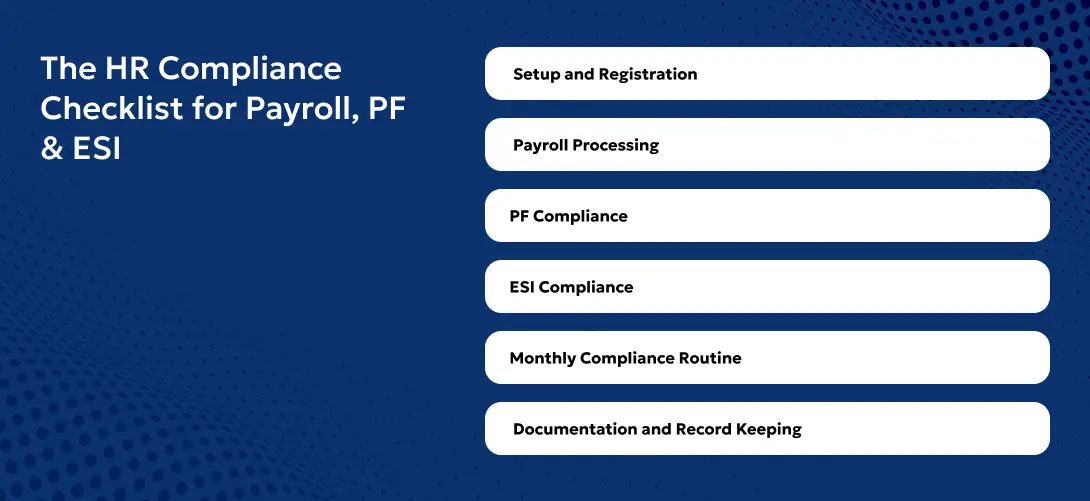
Managing payroll, PF, and ESI becomes easier when each step is clearly defined and followed in order. From employee records to salary processing and monthly filings, every part needs to be handled correctly.
When done consistently, it reduces errors, keeps timelines on track, and ensures your payroll stays compliant every month.
This is where everything begins, and getting this right makes the rest of compliance much smoother. You need to ensure your business is properly registered under PF and ESI wherever applicable, and at the same time, all basic registrations like PAN and TAN should be in place.
Employee records also need to be complete, including Aadhaar, bank details, and UAN, because missing information here can delay filings later. When your setup is clean and complete, your monthly compliance work becomes far less stressful.
Payroll is the core of compliance, and it needs to be handled with consistency every month. Salaries should be structured according to the new labour code, and minimum wage rules should always be followed based on your location.
For example, if the minimum wage for a role in your state is ₹15,000, the salary can’t be structured below that amount. And if the basic salary is increased as per the new wage rules, PF contributions will also increase accordingly.
At the same time, gross salary, deductions, and net pay must be calculated correctly, and payments should be processed on time. Even small errors here can carry forward into PF, ESI, and tax filings, so it helps to double-check before finalising.
PF compliance requires attention to detail because mistakes here are quite common and often go unnoticed for months. It is applicable to establishments with 20 or more employees, and generally covers employees earning up to ₹15,000 per month, although many companies extend it beyond this limit.
You need to identify eligible employees, and then calculate contributions based on the correct wage definition under the new rules. After that, ECR needs to be generated and contributions must be deposited within the due date.
Maintaining proper records is equally important for employers, because these are often reviewed during audits.
ESI compliance depends on employee eligibility, and this needs to be reviewed regularly as salaries change. It applies to establishments with 10 or more employees, and covers employees earning up to ₹21,000 per month.
You should identify which employees fall under this limit and ensure contributions are calculated accurately each month. Payments must be deposited on time, and returns should be filed as required.
At the same time, maintaining records helps when employees need to claim benefits, so delays or errors here can affect both compliance and employee trust.
This is where your entire checklist comes together, and consistency here makes the biggest difference. Every month, payroll inputs like attendance and salary changes should be verified before processing salaries.
Once payroll is completed, PF and ESI contributions need to be deposited, and filings should be completed without delay. Records must also be updated and stored properly. When this routine is followed regularly, most compliance issues are avoided without extra effort.
Documentation is often ignored until it is urgently needed, and that usually creates unnecessary stress. Payslips, statutory registers, employee records, and proof of filings should all be maintained properly and kept organised.
It also helps to store everything digitally, because it makes retrieval easier during inspections or audits. Good documentation doesn’t just support compliance, it also saves time when questions come up later.
These can be avoided by following a checklist, reviewing your process monthly, and keeping all records updated and easy to access.

Handling compliance internally can get difficult when deadlines, calculations, and changing rules all need attention at the same time. Small errors can repeat, and it becomes hard to stay fully confident about compliance.
Vishaal Consultancy Services helps you manage payroll, PF, and ESI with a clear and structured approach. Our team ensures accurate processing, timely filings, and regular updates on labour laws, so your compliance stays consistent and stress-free every month.
Managing payroll, PF, and ESI doesn’t have to feel complicated all the time. When your process is clear and consistent, things start falling into place. A simple HR Compliance Checklist like the one in this blog gives you that structure and helps you stay on track every month without confusion.
If you’re still unsure whether your compliance is being handled correctly or if it feels like too much to manage internally, it might be worth getting expert help. At, Vishaal Consultancy Services, we work closely with businesses to simplify compliance, reduce risks, and handle everything with clarity. Sometimes, having the right support just makes things easier.
Most of the time, it’s not about lack of knowledge. It’s because there’s no proper system in place. When tasks are handled manually or at the last minute, errors happen. A simple routine or checklist can solve most of these issues.
See Related Blogs
Fill in your details to download our exclusive e-learning document.
Fill in your details to download our exclusive e-learning document.
Fill in your details to download our exclusive e-learning document.