

Table of Content
Food labels do more than tell customers what’s inside a packet. They also help food businesses meet regulatory requirements, avoid compliance issues and keep product information clear. But with FSSAI issuing new notifications and directions, keeping track of what applies now and what comes later can get confusing.
The FSSAI new rules 2026 have brought several important changes to the labelling framework. At the same time, some changes announced in 2026 will only take effect in 2027. If your business manufactures, packs, imports or sells food, understanding these timelines matters before you update packaging or approve new artwork.
The FSSAI new rules 2026 make specific changes to the Food Safety and Standards (Labelling and Display) Regulations, 2020. FSSAI notified the amendment on 24 March 2026, but the changes will apply from 1 July 2027.
The main changes cover 4 areas:
Businesses won’t need to declare the per-serve percentage contribution to Recommended Dietary Allowances (RDA) or the number of servings per pack for infant nutrition products covered by the Food Safety and Standards (Foods for Infant Nutrition) Regulations, 2020.
This exemption applies only to these two declarations. Other labelling requirements still apply.
The amendment changes the nutrition information exemption for certain foods. It covers raw agricultural products such as wheat, rice, cereals, pulses, fruits and vegetables, as well as single-ingredient products.
It also defines minimally processed foods. These may undergo cleaning, grinding, refrigeration, pasteurisation, fermentation, freezing or vacuum packaging, as long as the process doesn’t substantially change their nutritional content.
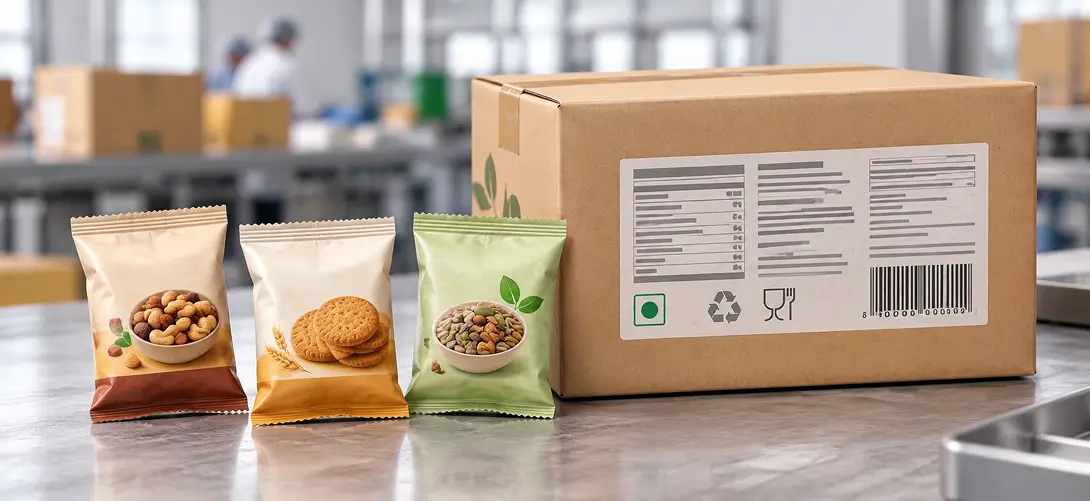
For packages with a surface area of 100 sq. cm or less, certain FSSAI-notified logos don’t need to appear on the individual pack.
The required information must still appear on the corresponding multi-unit package. Businesses should check the specific logo requirement before changing their packaging.
The amendment sets out clearer requirements for food containers meant for non-retail sale. These include the food name, FSSAI logo and licence number, applicable date marking, lot or code number, and the manufacturer’s or packer’s name and address.
Imported products must also include the applicable country-of-origin information. Some details, such as the ingredient list, veg/non-veg declaration and net quantity, can be provided through accompanying documents if the food remains traceable.
These changes are especially relevant to manufacturers, packers and businesses that supply food or ingredients to other businesses.
Non-retail containers may not reach consumers directly, but they still need to meet . Clear identification and traceability are essential when food moves between manufacturers, FSSAI labelling requirements appliers and other businesses.
Under the current framework, non-retail containers must carry the required information and be clearly marked as “NON-RETAIL CONTAINER” or “NON-RETAIL CONTAINER – NOT FOR DIRECT SALE TO CONSUMER.”
The required information must be prominent, legible and accessible during normal handling. For B2B businesses, compliance should therefore cover bulk packs, ingredient containers and supporting documents, alongside consumer-facing packaging.

FSSAI issued a direction on 22 July 2026 on the labelling of coffee-chicory mixtures. It relates to the 2025 amendment that introduced front-of-pack declarations showing the percentage of coffee and chicory.
The original requirement was due to take effect on 1 July 2026. The July 2026 direction changes the implementation timeline. Businesses should therefore follow the latest FSSAI direction instead of relying on the earlier deadline.
Avoid packaging and labelling compliance gaps by getting your product labels checked before the new requirements take effect.
The Food Safety and Standards (Labelling and Display) Regulations, 2020 remain the main labelling framework in 2026. The First Amendment Regulations, 2026 introduce specific changes, but these take effect from 1 July 2027.
For now, food businesses need to meet the applicable requirements for their product and packaging, including:
These requirements can differ based on the product category, package size and type of food business. Businesses should therefore review each label against the rules that apply to that specific product instead of using a standard label format across products.
For packaging changes made in 2026, businesses should follow the requirements currently in force. The specific changes introduced by the 2026 amendment need to be incorporated when they become applicable from 1 July 2027.
Need help reviewing FSSAI licence details, declarations, nutrition information and packaging requirements?
Selling food online doesn’t remove FSSAI labelling requirements. E-commerce food businesses must provide the required product information on their websites before purchase, wherever applicable.
For D2C brands, this means checking both the physical label and online product listing. The listing should show applicable ingredient, nutrition, allergen, vegetarian or non-vegetarian, and FSSAI information.
The information online should match the product packaging. Any difference can give customers incorrect product information and create a compliance issue.

The FSSAI new rules 2026 take effect from 1 July 2027, giving businesses time to plan the transition. The next step is to turn the applicable changes into an internal implementation plan.
Set a timeline: Map regulatory review, artwork approval, printing and production deadlines against the 1 July 2027 effective date.
Assign responsibilities: Decide who will handle regulatory review, packaging changes, approvals, procurement and production.
Plan packaging changes: Account for existing packaging stock and avoid unnecessary reprints by aligning changes with your regular packaging cycle.
Update documentation: Keep approved artwork, product specifications and compliance records current as changes are implemented.
Starting early can help businesses avoid last-minute packaging changes and give internal teams enough time to complete approvals before the new requirements take effect.
The FSSAI new rules 2026 introduce specific changes to food labelling, but most of these provisions take effect from 1 July 2027. Food businesses should use this time to understand which changes affect their products and plan their compliance updates early.
If you’re unsure where your business stands, Vishaal Consultancy Services can help you review your labelling requirements, identify compliance gaps and plan the changes needed before the new provisions take effect. Book your free consultation call, today!
Preparing new packaging or updating existing labels? Make sure your artwork is compliant before printing.
A food compliance consultant can review your labels, identify gaps and guide required updates. Vishaal Consultancy Services can help businesses assess their FSSAI requirements and prepare for upcoming regulatory changes.
See Related Blogs
BLOGS
BLOGS
BLOGS
Fill in your details to download our New Labour Code PDF.
Fill in your details to download our exclusive e-learning document.
Fill in your details to download our exclusive e-learning document.
Fill in your details to download our exclusive e-learning document.