

Vishaal Consultancy Services

Home / blogs / When Is CLRA License Mandatory?

When Is CLRA License Mandatory? Registration, Applicability & Process

the contract labour regulation and abolition act 1970

Introduction

Managing contract labour can feel like walking on a tightrope. You want the work to be done efficiently, but even a small compliance mistake can throw you into financial and legal troubles. The Contract Labour Regulation and Abolition Act 1970 is designed to protect workers and ensure employers follow clear rules.

Imagine depending on a contractor to pay your workers, only to discover later that wages were delayed or benefits weren’t given. Suddenly, your business is in court, and your reputation takes a hit. Scary, right?

That’s why we’ve created this blog for employers, HR managers, and business owners who want to stay compliant. We’ll guide you through CLRA registration, CLRA license applicability, the registration and license process, and practical tips so you can protect your business and manage your workforce smoothly.

Before diving into processes, let’s see why understanding the law matters for your business and workforce.

Understanding the Contract Labour (Regulation and Abolition) Act 1970

The Contract Labour Regulation and Abolition Act 1970 was introduced to prevent exploitation of contract workers and make employers accountable. The main purposes of this act are:
  • Ensure fair wages and timely payments.
  • Provide safe working conditions and welfare measures.
  • Hold principal employers responsible if contractors fail to comply.

Employers cannot leave compliance entirely to contractors – it doesn’t work that way. Because when there’s non-compliance, it can result in penalties, unpaid wages, and legal cases on the employer. That’s why understanding the Contract Labour Regulation and Abolition Act 1970 helps you stay proactive, protecting both your business and workers.

Next, let us look at registration and licensing, the first steps in CLRA compliance.

the contract labour regulation and abolition act 1970
Don’t wait, ensure CLRA compliance today!

What is CLRA Registration?

CLRA registration is the official recognition that a principal employer is following the Contract Labour Regulation and Abolition Act 1970. It is required for establishments hiring 20 or more contract workers.

Here’s Why CLRA Registration Matters:
  • CLRA registration proves that the employer is responsible for worker welfare, including timely wages and benefits.
  • Employers must submit company details, contractor agreements, and a list of contract employees to the registering officer.
  • Completing registration keeps your business legally compliant and reduces the risk of disputes with workers or authorities.
  • Registration is required before hiring contractors and ensures your business is protected under the Contract Labour Regulation and Abolition Act 1970.

What is CLRA License?

A CLRA license allows contractors to legally supply contract labour. It applies to the contractor, while registration applies to the principal employer.
  • Contractors with 20 or more workers must have a valid license under the Contract Labour Regulation and Abolition Act 1970.
  • The license ensures contractors can pay wages, provide welfare, and maintain proper records for their workers.
  • Employers who hire unlicensed contractors can be held responsible, showing the importance of CLRA license applicability.
  • Verifying the contractor’s license protects your business and keeps it legally compliant.

When is CLRA License Mandatory?

A CLRA license is required under the Contract Labour Regulation and Abolition Act 1970 whenever contractors supply 20 or more workers. It is mandatory for construction sites, government projects, and public sector work. Hiring unlicensed contractors can lead to fines and legal action.
Avoid Fines, Act Now! Contact Us, Today.

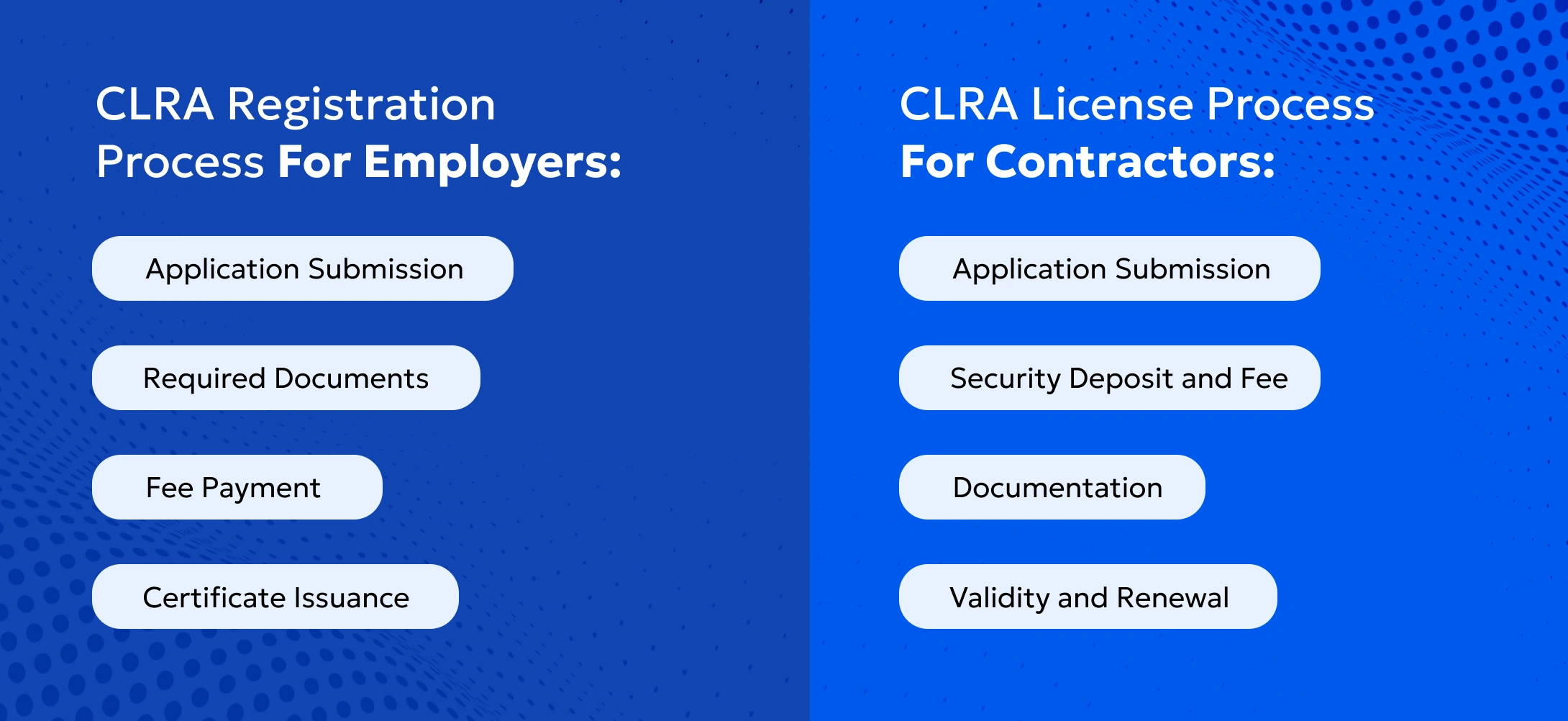
CLRA Registration and License Process

Knowing the step-by-step CLRA registration and license process helps employers comply efficiently.

CLRA Registration Process For Employers:

  • Application Submission: Fill Form I and submit it to the registering officer. This officially starts your compliance.
  • Required Documents: Include your company details, contractor agreements, and the list of contract employees because proper documentation helps you avoid delays.
  • Fee Payment: Pay the prescribed registration fee and keep the payment proof for your business audits later.
  • Certificate Issuance: Once approved, you receive a registration certificate valid for five years, confirming compliance.

CLRA License Process for Contractors:

  • Application Submission: Contractors fill out Form IV and submit it to the licensing authority to legally operate.
  • Security Deposit and Fee: Fees vary by number of workers, and a security deposit may be required to ensure accountability.
  • Documentation: Contractors provide proof of financial capacity, compliance records, and workforce details.
  • Validity and Renewal: Licenses are valid for one year and must be renewed before expiry to avoid lapses affecting both contractor and employer.
Following these steps precisely ensures both employers and contractors remain legally protected and reduces the chance of disputes.
the contract labour regulation and abolition act 1970

Real World Case Study On Ignoring CLRA Responsibilities

Let’s look at a recent case from Delhi where a government department learned the hard way what happens when contract labour rules are not followed.

Incident:

A group of watchmen (chuakidars) had been working for years under contractors at a government department (P.W.D./C.P.W.D.). When contractors failed to pay them properly, the workers demanded benefits and unpaid wages. Since the contractors were either missing or unresponsive, the workers took the matter to court.

Violations:

  • The department relied only on contractors and did not ensure proper CLRA compliance
  • Workers were denied benefits they were legally entitled to
  • When contractors failed, the principal employer did not step in to make payments as required under Section 21(4) of the CLRA Act

Outcome:

The Delhi High Court ruled that the government department, as the principal employer, had to pay the workers their wages. The court made it clear that if a contractor fails, the employer cannot walk away. Payments must be made to workers first, and the employer can recover the money from the contractor later.

Mistakes like these create financial risk, damage trust, and disrupt work. They also show how contract labour issues can grow into costly disputes. Employers must follow CLRA rules carefully and keep compliance watertight. With the right guidance from experts like Vishaal Consultancy Services, you can avoid such risks and ensure your workforce is managed lawfully, fairly, and smoothly.

Want to prevent legal trouble?
Talk to our experts

How Vishaal Consultancy Services Can Help Employers

Managing the Contract Labour Regulation and Abolition Act 1970 can be challenging, but expert guidance simplifies it. Vishaal Consultancy Services helps employers like you stay compliant and reduce legal risk.

We support businesses in the following ways:

  • Helping employers complete CLRA registration process accurately to avoid delays.
  • Assisting contractors with licensing, ensuring what is CLRA license and its requirements are met.
  • Conducting audits and checks to maintain proper records and ongoing compliance.
  • Providing advice to prevent disputes, ensuring workers are paid and managed legally.
Professional support allows you to focus on your business while staying legally safe.
the contract labour regulation and abolition act 1970

Conclusion

Managing contract labour responsibly is essential for protecting your business and employees. Proper CLRA registration, licensing, and following compliance steps safeguard against disputes, unpaid wages, and penalties. Employers who stay proactive save time, money, and stress.

Partnering with us at Vishaal Consultancy Services ensures your operations remain compliant. From registration and licensing to audits, payroll processing, and dispute prevention, we help you run your business efficiently while managing your workforce lawfully and fairly.

FAQs

CLRA registration shows that an employer follows the Contract Labour Regulation and Abolition Act 1970. It’s needed if you hire 20+ contract workers. It helps you avoid fines, delays in wages, and legal troubles.
Contractors fill out Form IV and submit it to the licensing officer with worker details, financial proof, and fees. The license is valid for a year and must be renewed to stay legal.
Vishaal Consultancy Services helps employers and contractors with CLRA registration and licenses. We check records, guide applications, prevent disputes, and make sure workers get paid and your business stays safe legally.

See Related Blogs

Scroll to Top