

Vishaal Consultancy Services

Home / blogs / what are workplace ethics

What Are Workplace Ethics and How Can Employers Implement Them Effectively?

what are workplace ethics

Introduction

Workplace issues rarely appear overnight. But as teams grow, small problems start showing up. Managers handle situations differently, employees feel decisions are inconsistent, and soon miscommunication or complaints begin to surface. When expectations aren’t clearly defined, even good employees can end up making the wrong decisions.

Many employers first assume these problems come from poor performance or attitude. In reality, the issue is often simpler because the organisation never established clear ethical standards. Without guidance, employees rely on personal judgement, and that creates confusion across teams.

This is where workplace ethics become important. In this blog, we’ll explain what workplace ethics mean, why they matter for organisations, and how employers can implement them effectively to build a more structured and professional workplace.

What Are Workplace Ethics?

Workplace ethics are the standards that guide the behaviour of how employees and employers in a professional environment. They define what conduct is acceptable at work and help maintain professionalism across the organisation.

The definition of workplace ethics refers to the values and principles that influence how employees perform their duties, interact with colleagues, and handle workplace responsibilities.

Workplace ethics are reflected in everyday actions such as:
  • treating colleagues with respect
  • following company policies
  • maintaining confidentiality of business information
  • admitting mistakes honestly
  • taking responsibility for work decisions
When these standards are clearly defined, employees understand their responsibilities and workplace behaviour becomes more consistent.

Why Workplace Ethics Are Important for Organisations

Workplace ethics play an important role in how smoothly an organisation operates. When expectations are clearly defined, employees understand how to behave at work and managers can make decisions more consistently. This reduces confusion and helps maintain a professional environment.
Clear ethical standards help organisations in several ways:
  • Builds trust within the organisation
    When employees see that decisions are fair and policies are applied consistently, they are more likely to trust leadership and workplace processes.
  • Reduces workplace disputes  
    Ethical guidelines set clear behavioural expectations, which helps prevent misunderstandings, complaints, and internal conflicts.
  • Creates a respectful work environment
    Workplace ethics encourage employees to treat colleagues professionally, which improves teamwork and communication across departments.
  • Maintains professional conduct
    When organisations define acceptable workplace behaviour, employees are more likely to act responsibly and follow established policies.
  • Supports labour law compliance
     practices naturally align with labour regulations, which helps organisations maintain compliance and reduce legal risks.
Workplace ethics are built on a few core principles that guide how employees and employers behave at work. Understanding these principles helps organisations apply ethical standards consistently.
what are workplace ethics

Key Principles of Workplace Ethics

Most ethical workplaces follow a few core principles that guide behaviour and decision making across the organisation. These principles help maintain consistency and professionalism at work.
  • Integrity: Employees and leaders act honestly and take responsibility for their actions.
  • Respect: Colleagues are treated with fairness and dignity, regardless of their role or background.
  • Accountability: Employees take ownership of their work instead of shifting blame when problems arise. 
  • Fairness: Workplace decisions such as promotions, evaluations, and opportunities should remain unbiased.
  • Transparency: Clear communication helps reduce misunderstandings and builds trust between employees and management. 
While these principles may seem straightforward, applying them consistently across teams can be challenging for many organisations.

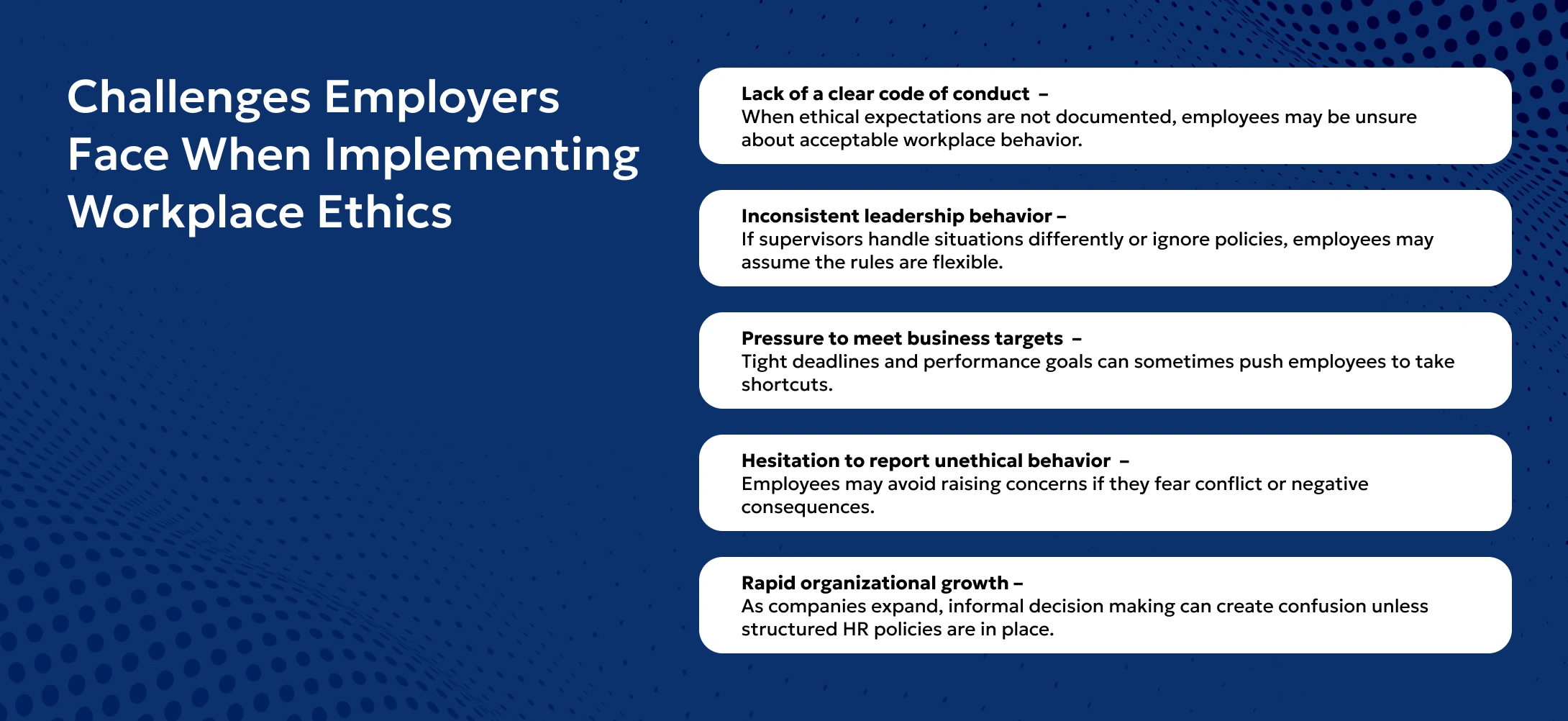
Challenges Employers Face When Implementing Workplace Ethics

Understanding workplace ethics is straightforward, but applying them consistently across an organisation can be difficult. Without clear systems and guidance, ethical standards may not be followed the same way by everyone.
Some common challenges employers face include:
  • Lack of a clear code of conduct
    When ethical expectations are not documented, employees may be unsure about acceptable workplace behaviour.
  • Inconsistent leadership behaviour
    If supervisors handle situations differently or ignore policies, employees may assume the rules are flexible.
  • Pressure to meet business targets
    Tight deadlines and performance goals can sometimes push employees to take shortcuts.
  • Hesitation to report unethical behaviour
    Employees may avoid raising concerns if they fear conflict or negative consequences.
  • Rapid organisational growth
    As companies expand, informal decision making can create confusion unless structured HR policies are in place.

To understand how these challenges can affect organisations in real situations, let’s get into the following case.
what are workplace ethics

Case Study

Context:

A healthcare organisation in Indore faced a workplace harassment complaint from a female employee. When the issue was reported, it was discovered that the organisation had not established an Internal Complaints Committee as required under the Sexual Harassment of Women at Workplace (Prevention, Prohibition and Redressal) Act, 2013.

Since the organisation had no internal mechanism to handle the complaint, the employee approached the Local Complaints Committee for intervention.

The Issue:

The dispute centred on whether an employer could ignore mandatory compliance requirements under the POSH Act. The organisation’s actions included:
  • Failing to establish an Internal Complaints Committee despite employing more than ten workers.
  • Not providing a formal internal process for employees to report harassment.
  • Ignoring statutory obligations meant to ensure a safe and respectful workplace.

The Trigger:

Since there was no internal system to handle the complaint, the employee approached the Local Complaints Committee. The matter was later examined to determine whether the organisation had failed to comply with the POSH Act.

The Impact:

The Madhya Pradesh High Court ruled that employers must follow the POSH Act and establish an Internal Complaints Committee. The organisation was penalised and directed to implement the required compliance measures.

What You Learn:

Employers must provide a safe workplace and a proper system for employees to report concerns. Ignoring legal requirements like forming an Internal Complaints Committee can lead to penalties and reputational damage.

How Vishaal Consultancy Services Can Help You

Implementing workplace ethics becomes easier when organisations have clear HR systems and compliance support. At Vishaal Consultancy Services, we help businesses build structured frameworks that promote fair practices, transparency, and responsible workplace behaviour.

We support employers with labour law advisory, statutory compliance such as PF and ESI, payroll management, and workplace policy development. With the right systems in place, organisations can reduce disputes, stay compliant, and maintain a more professional work environment.

what are workplace ethics

Conclusion

Workplace ethics influence how people behave, communicate, and make decisions at work. When organisations have clear policies and proper systems, employees understand expectations and work with confidence. This reduces confusion, builds trust within teams, and helps create a respectful work environment.

Many organisations find it difficult to build structured HR systems and keep up with compliance requirements as they grow. At Vishaal Consultancy Services, we help businesses develop practical HR policies and manage labour law compliance. If you want stronger workplace systems, book a consultation with us and get started.

FAQs

Start by setting clear code of conduct, document key HR policies, and communicate expectations to employees. When managers apply these rules consistently and employees know where to raise concerns, ethical behaviour becomes part of everyday workplace culture.
When ethical standards are clear, employees know how decisions are made and what behaviour is expected. This builds trust, reduces internal conflicts, and improves teamwork. Over time, it creates a more stable workplace where people feel respected and work more confidently.

If you’re unsure where to start, we can guide you. At Vishaal Consultancy Services, we help organisations build practical HR policies, manage labour law compliance, and set up clear workplace systems so you can maintain ethical practices as your business grows.

See Related Blogs

Scroll to Top