
Vishaal Consultancy Services

Home / blogs / Standing Order in Labour Law:

Standing Order in Labour Law: A Complete Guide for Employers

Standing order in labour law

Introduction

Can you terminate an employee just by relying on a clause in your certified standing orders, without giving them a chance to explain?

This question came up in a well-known case where a large public sector airline removed employees by using a standing order clause but skipped the domestic enquiry. The courts later made it clear that even certified rules cannot replace basic fairness and due process.

In many organisations, HR policies look neat on paper but become unclear when a real dispute happens. When decisions on discipline, attendance, or termination are questioned, employers often realise they do not have a legally strong framework to support their actions. That is where the standing order in labour law becomes important.

In this blog, we’ll explain how the standing order in labour law works, when it applies, and how it helps you reduce risk.

What Is a Standing Order in Labour Law?

A standing order in labour law is a set of written service rules that govern daily employment, covering classification, working hours, attendance, leave, misconduct, discipline, and termination. Once certified, it is legally binding. It replaces informal practices with approved procedures, ensuring consistent decisions, reducing confusion, and giving stronger legal backing for HR actions across the organisation.

Why Does a Standing Order in Labour Law Matter?

  • It ensures disciplinary actions are taken strictly as per the standing order in labour law and do not appear arbitrary.
  • It reduces disputes by providing a clear, documented basis for management decisions.
  • It strengthens the employer’s position before Labour Authorities by showing that due process was followed.
  • It supports inspection readiness, as inspectors commonly ask for certified standing orders.
  • It ensures uniform treatment of employees across departments, shifts, and supervisors.
When implemented correctly, a standing order in labour law functions as a practical risk management tool rather than just a compliance requirement
Standing order in labour law

When Employers Must Implement Standing Orders

For you as an employer, applicability depends on your workforce size, not on receiving a notice. Missing this trigger often leads to compliance issues during inspections or disputes.
  • Applicability depends on workforce size, not notices.
  • Required once employee count crosses the notified threshold.
  • Traditional limit: 100 workers; some states have lower limits.
  • Industrial Relations Code proposes 300 workers, subject to notification.
  • Review headcount regularly and implement early to stay inspection-ready and reduce compliance risks.
Monitor your workforce and implement the standing order in labour law before crossing the threshold to stay inspection-ready and minimise compliance risks.

What Must Be Covered in Standing Orders

A standing order in labour law is a practical guide for managers and HR to handle day-to-day workforce matters without confusion. It ensures consistency, fairness, and legal compliance.
  • Define your employee categories, such as permanent, temporary, probation, or contract workers, so you know who falls under which rules.
  • Document working hours, shifts, attendance, leave types, and overtime rules to manage your teams smoothly.
  • Specify wage payment timelines, deductions, allowances, and overtime payments to avoid payroll disputes.
  • List misconduct types and the step-by-step disciplinary actions you will follow for consistency.
  • Explain the domestic enquiry process, including evidence collection and hearings, so you handle cases fairly.
  • Define suspension and termination rules to ensure your actions comply with labour law. 
Having these points clearly documented helps managers take confident decisions, reduces disputes, and ensures employees understand expectations and consequences in advance.

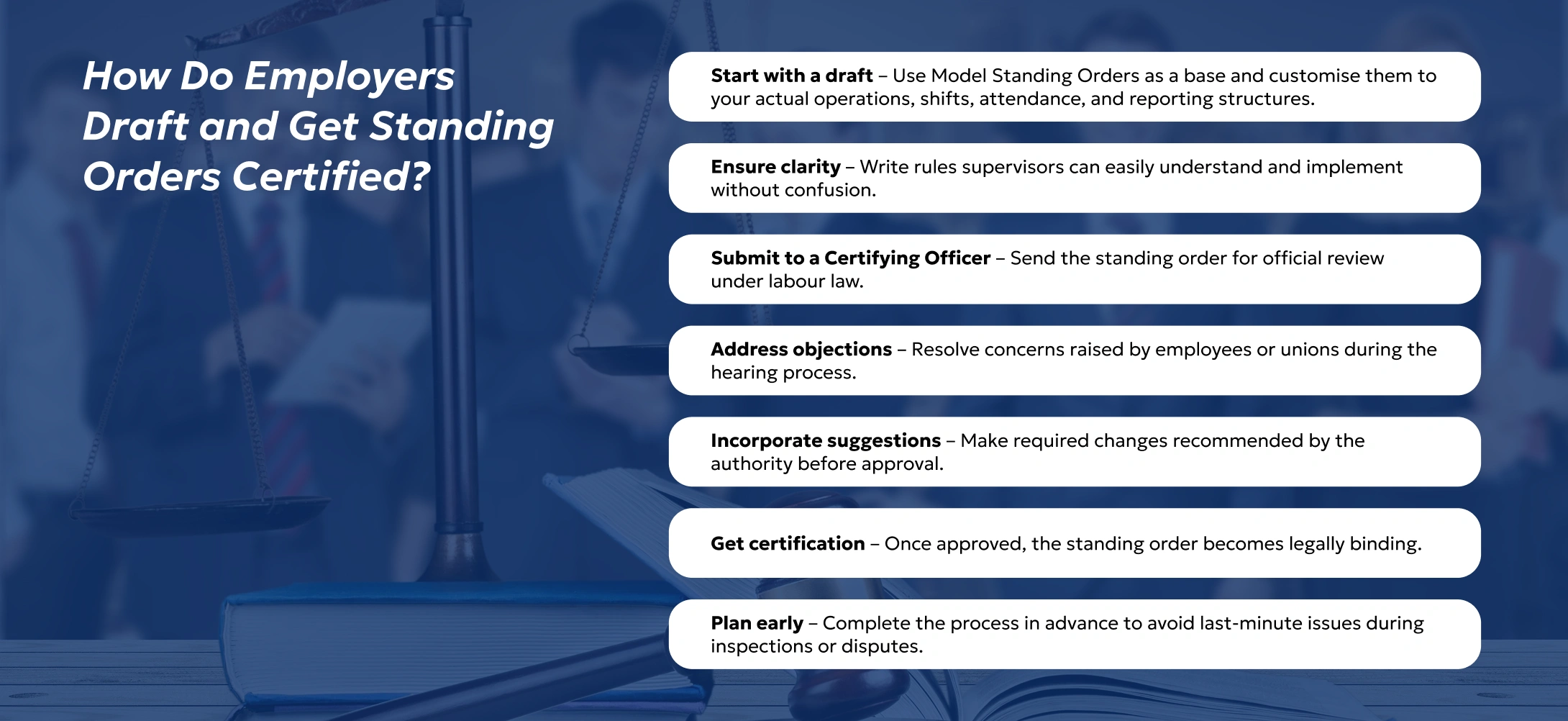
How Do Employers Draft and Get Standing Orders Certified?

If you are preparing a standing order in labour law, it helps to know the exact steps from drafting to certification so you can plan timelines and avoid last-minute issues.
  • Start with a draft: Use Model Standing Orders as a base, but customise them to your actual operations, shifts, attendance, and reporting structures
  • Ensure clarity: Write rules that supervisors can follow easily without confusion
  • Submit to Certifying Officer:  Send the standing order in labour law for official review. 
  • Address objections: Employees or unions may raise concerns, which are reviewed during a hearing.
  • Incorporate suggestions: Make updates if the authority recommends changes before approval.
  • Get certification: Once approved, the standing order in labour law becomes legally binding.
  • Plan early: Completing the process ahead of time prevents last-minute stress during inspections or disputes.
Standing order in labour law

How Should Employers Act After Certification?

Certification of a standing order in labour law is just the first step. Employers must display the approved document , train supervisors and HR to follow the procedures exactly, and handle similar cases consistently across departments.

Clear communication with employees is also essential, so they understand expectations and misunderstandings are minimized. Proper implementation ensures the standing order in labour law protects the organisation and supports fair workplace management

Common Mistakes You Should Avoid While Drafting Standing Orders

Standing Orders define how workplace rules are applied, and small drafting gaps can later lead to disputes. To keep your standing order in labour law clear and workable, these are mistakes you should be mindful of.
  • Relying fully on Model Standing Orders without customisation makes rules irrelevant.
  • Vague definitions of misconduct or disciplinary action create confusion and weaken decisions.
  • Not informing employees before submission leads to objections and delays.
  • Ignoring state-specific rules can affect approval.
  • Outdated policies lose relevance and may fail during disputes.
Addressing these early keeps your standing order in labour law clear, practical, and legally enforceable.

Case Study

Context:

Air India ended the employment of some workers by using a clause in its certified standing orders. This clause allowed the company to terminate employees by giving notice or salary in place of notice, without holding a proper disciplinary enquiry. The employees were removed from service suddenly and were not given a chance to explain or defend themselves.

The Issue:

The question before the court was whether an employer can rely on a standing order to terminate employees without following natural justice. Actions included:
  • Terminating employees solely based on a standing order clause.
  • Skipping domestic enquiries.
  • Ignoring fairness and due process required under labour law.

The Trigger:

Employees approached the Bombay High Court, arguing the termination was arbitrary and unfair.

The Impact:

The court ruled in favour of the employees:
  • Reinstatement was ordered.
  • 50% back wages were awarded.
The Supreme Court later upheld this decision, making the ruling final.

What You Learn:

Standing orders are binding on both employers and employees, but they must be applied lawfully. Employers must follow natural justice and proper procedures, even when acting under certified standing orders. Misuse of standing orders can lead to reinstatement, back wages, and serious legal consequences.
Case-Study - Standing Order In Labour Law

How Vishaal Consultancy Services Can Help You

Managing a standing order in labour law can be complex, and mistakes can lead to disputes or compliance risks. We at Vishaal Consultancy Services help businesses draft, revise, and certify standing orders, train HR teams, and provide ongoing support so compliance becomes effortless.

Contact us today to make sure your standing orders are legally sound, implemented correctly, and protect your organisation at every step.

Conclusion

Having clear service rules brings stability and fairness to your organisation. When discipline, attendance, and termination procedures are defined and followed, decisions become consistent and defensible. A standing order in labour law documents everyday HR actions, reducing disputes and protecting your business.

If you’re unsure about applicability, drafting, or certification, it’s the right time to get expert help. We at Vishaal Consultancy Services guide employers and HR teams in creating, certifying, and implementing compliant standing orders. Reach out to us today to make compliance simple, effective, and reliable.

FAQs

Not all, but if your organisation has 100 or more employees (as per traditional rules) or reaches the notified threshold in your state, a certified standing order in labour law is mandatory. Regular headcount checks can prevent compliance risks.
No. Even a certified standing order in labour law cannot replace 1 proper domestic enquiry and fair notice. Skipping these steps can lead to reinstatement and awarding partial back wages, as seen in the case study.
Review your standing order in labour law at least once a year or whenever major changes occur in shifts, policies, or workforce structure. This keeps rules relevant, legally compliant, and reduces disputes during inspections.

See Related Blogs

Scroll to Top