

Table of Content
Hiring decisions affect productivity, compliance, and team efficiency more than many employers realise. The way an organisation chooses its workforce—whether permanent employees, contract staff, or temporary workers—can significantly influence business performance.
Many organisations focus only on filling open roles quickly. However, choosing the right type of staffing is just as important as hiring the right candidate. A poor staffing structure can lead to operational disruptions, legal risks, and higher costs, while the right approach ensures flexibility, efficiency, and long-term stability.
Staffing is not just about recruitment. It also involves determining which staffing model best suits business needs, managing workforce flexibility, and ensuring compliance with labour regulations.
In this blog, you will learn what staffing means, the main types of staffing, and why choosing the right staffing structure is important for employers.
Staffing refers to the process of identifying workforce requirements and ensuring the organisation has the right people with the right skills at the right time.
It includes activities such as workforce planning, recruitment, selection, onboarding, and workforce management. One important aspect of staffing is deciding how employees should be engaged with the organisation.
Different roles require different staffing approaches. Some positions need long-term employees, while others require short-term specialists or project-based workers.
Understanding the types of staffing in management helps organisations create a workforce that is efficient, flexible, and capable of meeting changing business demands.
Not sure which staffing model is right for your workforce and business requirements?
Permanent staffing refers to hiring employees for long-term roles within the organisation. These employees receive full-time employment benefits and are integral to the organisation’s operations.
Permanent staff typically handle critical roles that require stability, organisational knowledge, and long-term commitment.
Benefits include:
Temporary staffing involves hiring employees for a short period to meet immediate workforce needs. This approach is com monly used during seasonal demand, employee absence, or short-term projects.
Temporary staff may work through staffing agencies or direct contracts with the organisation.
Advantages include:
Contract staffing involves hiring professionals for a specific project or time period under a contractual agreement. These employees are typically specialists hired to complete particular tasks.
Contract staffing is widely used in industries like IT, engineering, consulting, and project-based services.
Key advantages include:
Part-time staffing involves hiring employees who work fewer hours than full-time staff. This type of staffing is common in industries such as retail, education, hospitality, and customer service.
Part-time staffing allows organisations to manage workloads efficiently without committing to full-time employment costs.
Benefits include:
Outsourcing involves delegating certain functions or roles to external service providers. Instead of hiring employees directly, organisations work with third-party agencies that manage the workforce.
This approach is commonly used for functions such as payroll processing, IT support, recruitment, and customer service.
Advantages include:
Outsourcing allows companies to focus on core business activities while external experts handle specific functions.

Build a flexible workforce without increasing your HR and compliance burden.
Need permanent, contractual or flexible staffing support for your growing business?
Incident:
Challenges Identified:
Outcome:
Takeaway for Employers:
Choosing the right type of staffing ensures operational flexibility and prevents disruptions during unexpected business changes.

Choose a staffing structure that balances workforce requirements, cost and compliance.
Many organisations struggle to determine the most suitable staffing structure for their workforce needs. Without proper planning, businesses may face compliance issues, inefficiencies, and workforce imbalances.
With expert guidance, businesses can implement effective staffing strategies that support sustainable growth.
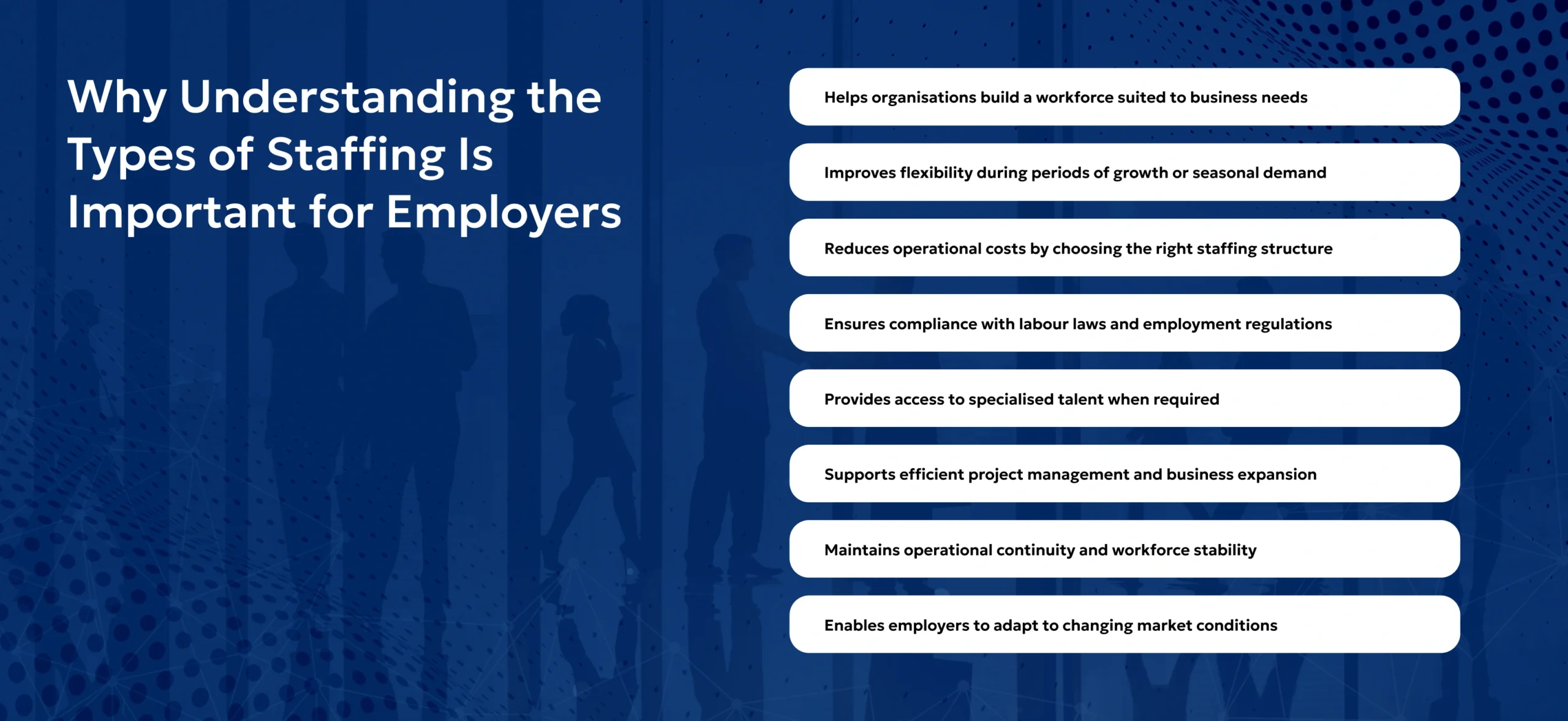
Understanding the types of staffing is essential for employers who want to build a flexible, efficient, and compliant workforce. From permanent and temporary employees to contract and outsourced professionals, each staffing model serves a specific purpose in organisational management.
Choosing the right staffing structure helps organisations improve productivity, manage costs, and adapt to changing business demands.
Vishaal Consultancy Services supports organisations in designing structured and compliant staffing systems. Their expertise in recruitment frameworks and workforce planning helps businesses build reliable teams and achieve long-term stability.
Struggling with manpower shortages or changing workforce requirements? Our staffing team can help.
Employers should assess workload, project duration, required skills, and long-term business plans before deciding on a staffing model. Consulting HR experts can help ensure the staffing structure supports both operational efficiency and compliance.
See Related Blogs
BLOGS
Fill in your details to download our New Labour Code PDF.
Fill in your details to download our exclusive e-learning document.
Fill in your details to download our exclusive e-learning document.
Fill in your details to download our exclusive e-learning document.