

Table of Content
Running an industrial unit in India is not just about land, machinery, or manpower. Many employers only realise the risks when a notice lands on their desk or authorities start questioning their operations.
Some assume industrial licensing is outdated and does not apply anymore. But ignoring it can have serious consequences. For example, there have been businesses that faced legal trouble and even tragedy for skipping licensing requirements. One incident in Tamil Nadu shows just how high the stakes can be when rules are overlooked, which we’ll discuss later in the blog.
Employers need to understand what the law expects and how to prevent problems before they escalate. In this blog, we’ll discuss the industrial licence policy in India and its legal requirements.
The industrial licence policy refers to a set of legal rules that require certain industrial activities to obtain government approval before they can operate or expand. This requirement applies mostly to industries that involve public safety risks, environmental concerns, or strategic importance.
Unlike registration, which just records your business, a licence permits you to carry out specific activities under specific conditions. Many employers miss this distinction and think they are compliant when they aren’t.
In simple terms, this policy is about permission and conditions, not just paperwork.
Now let’s see where these rules come from and how they work in real life.
Industrial licenses in India are governed by the Industries (Development and Regulation) Act, 1951, which lets the government regulate industries that pose risks to safety, the environment, or national security.
Some sectors remain closely monitored under the industrial licensing policy in India, enforced by the Ministry of Commerce and Industry and DPIIT. This law is still active and enforceable, so taking it seriously is essential for employers.

Many employers assume only a new unit needs approval, but the industrial licence policy applies to all these changes if your activity falls under regulated industries.
Even seasonal or temporary operations must follow the rules. Authorities focus on what you are actually doing, not what you planned to do. It’s crucial for you to follow these rules to stay compliant and avoid penalties.
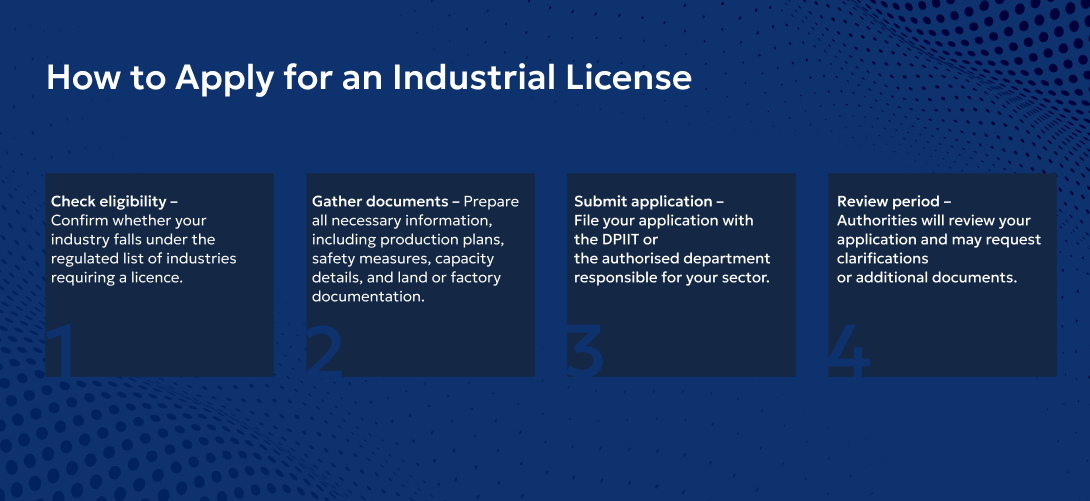
Applying for an industrial licence under the industrial licence policy may seem daunting at first, but it’s straightforward if you know the steps and prepare the right documents. Being organized can save you time and prevent delays or rejections.
Here’s a simple step-by-step guide:
The most common issue is employers submitting incomplete documents or leaving out safety plans, which can slow down approvals and, in some cases, even lead to the application being rejected.
Once your licence is approved, it becomes a legal document that defines how you can operate your unit. If you follow the correct process, your operations will be compliant, safe, and protected under the law.
An industrial licence isn’t just permission to run a factory. It comes with conditions you must follow to stay compliant and avoid penalties.
Some common conditions include:
These rules aren’t optional. Breaking them can be just as serious as running without a licence. Licences are often linked with other laws, like the Factories Act and environmental regulations, so regular internal checks are essential.
Next, let’s look at why these rules matter by looking at the consequences when they aren’t followed.
The Incident:
Legal Fallout:
Final Outcome:
What Employers Should Learn:

Avoid disasters like this. Talk to our experts today!
For regulated industries, every document and process must meet the industrial licensing policy, or your application could be delayed or rejected. Even after approval, staying compliant is essential to avoid penalties or disruptions.
Managing this in-house can be complex. And at Vishaal Consultancy Services, we provide end-to-end support, from checking if a licence is needed and preparing your application to ensuring ongoing compliance with safety, labour, and environmental regulations.
With our expert guidance, you can focus on running your business while keeping operations fully compliant and legally protected.
The industrial licence policy is still a critical requirement for certain sectors in India. It ensures that businesses with potential risks operate safely and under government oversight. Employers must know when a licence is needed, how to apply, and the conditions that come with it. Ignoring these rules can lead to serious legal trouble, fines, or operational disruptions, as demonstrated in the fireworks case study.
If your business falls under a regulated category, don’t wait for issues to arise. Contact Vishaal Consultancy Services today for expert guidance, end-to-end support, and practical solutions to stay fully compliant and protected.
See Related Blogs
BLOGS
Fill in your details to download our New Labour Code PDF.
Fill in your details to download our exclusive e-learning document.
Fill in your details to download our exclusive e-learning document.
Fill in your details to download our exclusive e-learning document.