

Table of Content
Running a business already comes with pressure. Hiring people, managing payroll, handling customers, and meeting targets. In all that rush, compliance often feels like paperwork that can wait. But when filings are missed, returns are wrong, or submissions get delayed, notices, penalties, and inspections quickly take over the calm.
Many business owners and HR teams do not fully understand what is statutory reporting until a legal notice lands on their desk. The stress that follows is real – fines, blocked payments, audits, and damaged reputation. But when statutory reporting is handled the right way, it quietly protects the business in the background.
In this blog, we’ll explain how it works, where it comes from, and how it shapes daily business operations.
Statutory reporting is the legal process of submitting mandatory business, employee, and financial information to government authorities within fixed timelines. These filings are required by law and missing them can lead to penalties, audits, and legal action.
In simple words, the statutory reporting meaning is proving that your business follows labour laws, pays taxes correctly, and maintains proper employment records. It applies to startups, factories, contractors, and corporate offices alike.
The statutory reporting definition includes payroll filings, tax returns, employee benefit records, and company compliance reports under labour, financial, and corporate laws. These reports protect your business during inspections, audits, funding checks, and disputes.

Labour laws control how businesses manage employee records, wages, benefits, and working conditions. Acts such as EPF, ESI, Bonus, Gratuity, Contract Labour, and Shops and Establishments ensure that employee rights are protected and employer duties are tracked through mandatory disclosures..
Financial laws regulate how income, profits, and indirect taxes are declared. The Income Tax Act and GST Act form the backbone of financial statutory reporting and help the government track tax compliance, turnover accuracy, and transaction transparency.
Corporate laws under the Companies Act govern how companies disclose ownership, management decisions, and financial standing. These laws ensure legal identity, corporate transparency, and proper governance at the company level.
Each legal system controls a separate compliance area. Ignoring even one can expose the business to inspections, penalties, and legal action.
Now that the legal authority is clear, the next step is understanding what reporting work actually looks like inside a business. .
This includes ROC filings, annual returns, director disclosures, and board resolutions. These filings keep the company legally active and prove that internal governance rules are being followed.
Factories, construction firms, and contract labour employers must also submit safety records, contractor reports, and workforce compliance data based on workforce size and operational risk.
To answer the burning question, “What is statutory reporting?” it is a daily operational responsibility that runs across the organisation.
Statutory reporting requirements depend on company size, employee strength, industry type, and state rules. Still, most businesses follow three fixed reporting cycles.
PF, ESI, GST, and payroll linked statutory deposits fall under this cycle. Since these move with salary processing, even small data mismatches can create compliance gaps.
Advance tax payments and professional tax filings are handled here. These are often delayed when finance teams focus only on daily operations.
Income tax returns, tax audit reports, ROC annual filings, and bonus and gratuity reconciliations are completed at the year end. These filings reflect the overall compliance health of the company.
When these reports connect directly with payroll, attendance, exits, and vendor payments, accuracy becomes non-negotiable.

Even when work is delegated, legal responsibility stays with the leadership. In case of default, authorities hold directors and business owners accountable, not junior staff.
When these roles overlap without coordination, small statutory gaps go unnoticed at first and later surface as penalties, notices, or inspection issues.
PF or ESI challan mismatch delays salary processing and this one missed deposit can trigger panic across teams.
This is the real cost of weak statutory reporting. Not just penalties, but broken workflows and rising pressure.
Most businesses do not fail because they ignore statutory reporting. They fail because small delays and small errors quietly pile up until inspections and penalties begin.
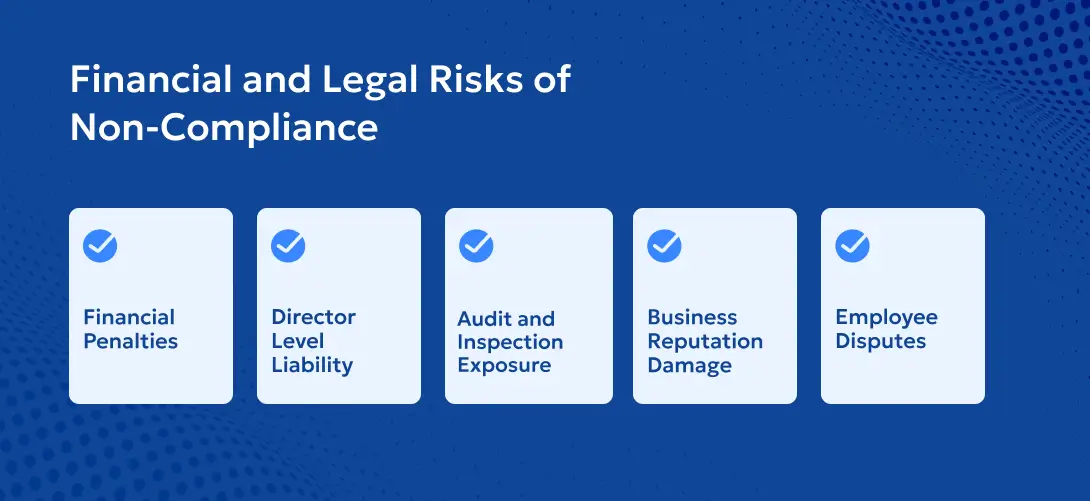
1. Financial Penalties: Late PF, ESI, Income Tax, and GST filings attract heavy penalties and interest.
2. Director Level Liablibilty: Repeated defaults can lead to personal liability and prosecution of directors.
3. Audit and Inspection Exposure: Errors in financial statutory reporting often trigger full-scale audits and government inspections.
4. Business Reputation Damage: Non-compliance affects tender eligibility, vendor confidence, and bank funding.
5. Employee Disputes: Delayed statutory benefits increase the risk of labour complaints and court cases.
The MCA imposed a penalty of ₹3,00,000 on the company and ₹50,000 each on the defaulting officers, including the Managing Director, CFO, and Company Secretary.
This case shows that statutory reporting is not limited to financial statements. Omitting required social and labour-law disclosures can lead to significant fines and reputational damage.
And, to avoid this? you need to keep a checklist, review reports, and consult experts to ensure all disclosures are accurate.
Vishaal Consultancy Services keeps your business compliant without adding load on your HR or finance teams. We manage risk quietly in the background, so your daily operations stay uninterrupted.
Our support covers end to end statutory reporting, PF and ESI compliance, payroll linked filings, labour law and financial audits, notice handling, and preventive compliance planning.
For growing businesses, this builds strong systems. For established companies, it protects reputation, leadership, and long-term stability.
From payroll and taxes to employee welfare and audits, statutory reporting connects quietly with every business function. Once you clearly understand what is statutory reporting, its legal roots, operational impact, and risks, it stops feeling like paperwork and starts feeling like a protection system that holds the business steady.
If you want to avoid penalties, audits, notices, and business disruption, it is time to get expert support. Reach out to Vishaal Consultancy Services today and put your statutory compliance in safe hands while you stay focused on growing your business.
Yes, many parts of statutory reporting can be automated using payroll, GST, and compliance software. But automation still needs human review. One wrong setting can cause repeated filing errors across multiple returns.
Most statutory records should be preserved for at least 7 to 10 years. This includes payroll, tax filings, registers, and audit reports. Old records are often required during inspections, disputes, or delayed government audits.
The earliest warning sign is inconsistency. PF or ESI challans not matching payroll, GST credits getting blocked, or repeated return rejections usually signal deeper compliance gaps that need immediate attention.
See Related Blogs
Fill in your details to download our New Labour Code PDF.
Fill in your details to download our exclusive e-learning document.
Fill in your details to download our exclusive e-learning document.
Fill in your details to download our exclusive e-learning document.