

Vishaal Consultancy Services

Home / blogs / Provident Fund Rules for Employer

Provident Fund Rules for Employer: Are You Fully Compliant?

provident fund rules for employer

Introduction

What happens when an employer overlooks provident fund rules? Many think it is just some paperwork, but the truth is – it’s far more serious.

In reality, ignoring PF compliance rules can lead to heavy fines, court cases, and even damage to your company’s name. The Supreme Court’s 2019 judgment proved this when it ruled that employers cannot escape contributions by calling wages “allowances.” That decision changed the way many businesses now look at company provident fund rules.

So, is PF mandatory for all companies? The law in India makes it very clear that provident fund is not just an option. These pf compliance rules are statutory obligations, and staying compliant is part of building both legal safety and employee trust.

If you are an employer, this guide will help you understand the Provident Fund rules for employers in the simplest way. We’ll cover contribution rules, compliance checklists, common mistakes to avoid, and even a real case study to show why following PF compliance in India matters.

What is Provident Fund and Why Does it Matter?

The Provident Fund (PF) is a government-managed retirement savings scheme under the Employees’ Provident Funds and Miscellaneous Provisions Act, 1952. Both employers and employees contribute a portion of wages to this fund, which helps employees build long-term financial security.

For employers, PF isn’t just a payroll deduction, it is both a legal duty and a key part of employee welfare. Contributing correctly and on time ensures compliance, builds goodwill, and keeps your organization free from statutory disputes.

provident fund rules for employer

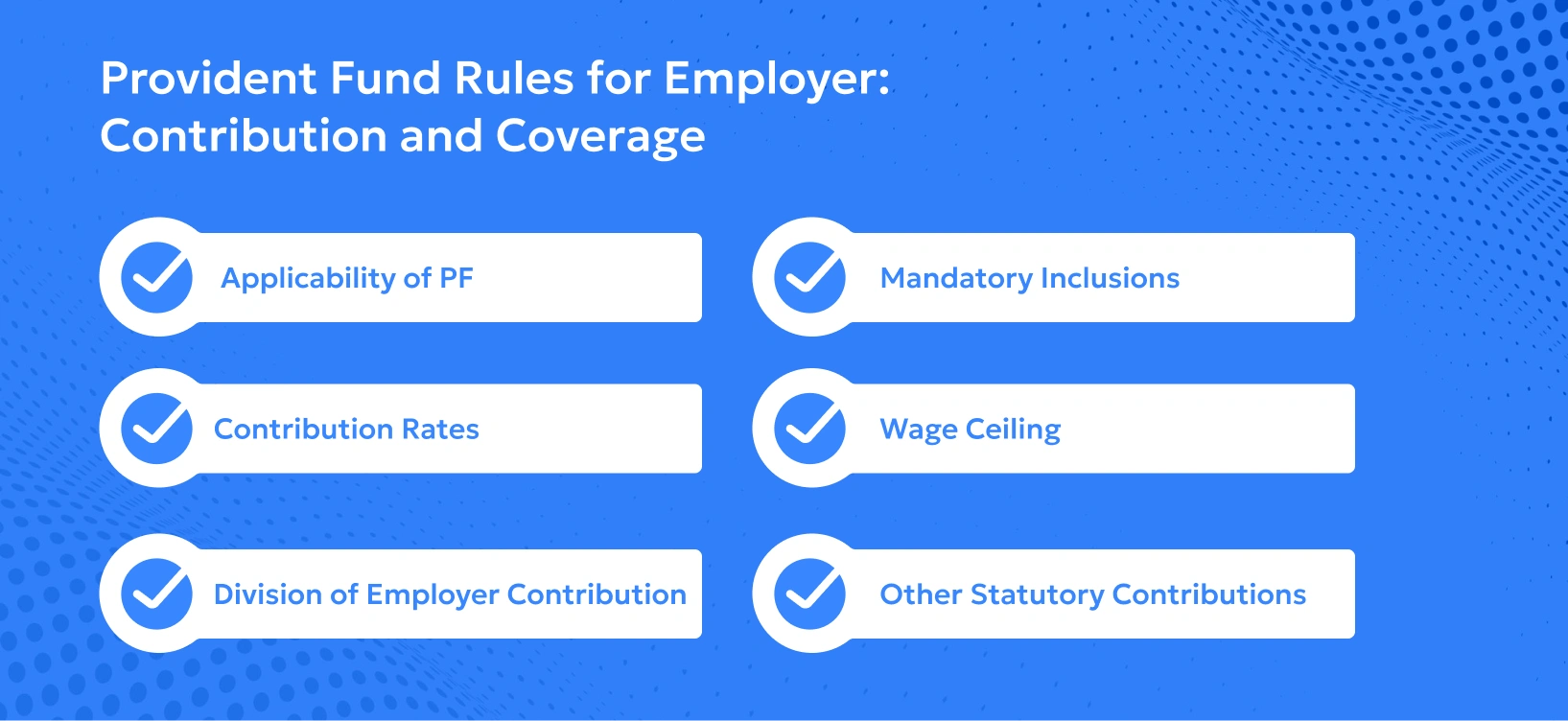
Provident Fund Rules for Employer: Contribution and Coverage

Every employer must understand the exact requirements under the law. Below are the core provident fund rules for employer to follow:
  • Applicability of PF: Companies with 20 or more employees must register under the Employees’ Provident Fund Organisation (EPFO). Smaller establishments may also opt in voluntarily.
  • Contribution Rates: Both employer and employee normally contribute 12% of the employee’s basic wages plus dearness allowance. Certain establishments with fewer than 20 workers, or specific notified categories, can contribute at a reduced rate of 10%.
  • Division of Employer Contribution: Out of the employer’s 12% share, 8.33% goes to the Employees’ Pension Scheme (EPS), subject to a monthly wage ceiling of ₹15,000. This means the maximum EPS contribution is ₹1,250 per month, and the remaining balance is credited to the Provident Fund account.
  • Mandatory Inclusions: Basic wages, dearness allowance, and retaining allowance (if any) are all subject to PF contributions. Splitting salaries into multiple allowances to reduce PF liability has been disallowed by the Supreme Court.
  • Wage Ceiling: PF membership is mandatory for employees earning up to ₹15,000 per month. New employees earning above this limit at the time of joining are treated as excluded, unless both employer and employee agree to opt in. Existing members, however, continue even if their monthly wages cross ₹15,000 later.
  • Other Statutory Contributions: Employers must also make contributions toward the Employees’ Deposit Linked Insurance (EDLI) Scheme and bear the administrative charges notified by EPFO.
These company provident fund rules are non-negotiable and form the backbone of statutory compliance for employers.
provident fund rules for employer
Not sure if your payroll process is meeting every PF deadline?
Contact us before the penalties strike.

PF Compliance Rules: Working Hours and Employer Obligations

PF compliance rules go beyond simple contributions. Employers are required to follow several procedural obligations to stay compliant. Here’s what every HR or payroll manager must ensure:
  • PF Registration: Companies meeting the threshold of 20 employees must register with EPFO within one month of becoming eligible.
  • Timely Deposits: Contributions must be deposited by the 15th of the following month without fail. Delays attract damages and interest.
  • Filing Returns: Employers must submit monthly electronic challans and returns through the EPFO portal.
  • Record Maintenance: Accurate records of wages, contributions, and employee details must be maintained and readily available for inspections.
  • Providing UAN (Universal Account Number): Every employee must be linked to a UAN to ensure portability and transparency of PF accounts.
  • Compliance with Inspections: Employers must cooperate with EPFO officials during inspections and audits.
Failure to meet these PF compliance rules can result in penalties, prosecutions, and even criminal liability in severe cases.

Employer Checklist for PF Compliance in India

Managing provident fund compliance can feel complex, but a clear checklist can make the process simple and stress-free. Use the following as a quick PF compliance guide for your company:

  • Register your establishment promptly with EPFO once the employee threshold is reached.
  • Deduct and deposit PF contributions before the 15th of each month.
  • Accurately calculate PF on basic wages, DA, and other eligible allowances.
  • Issue UANs and ensure employees can access their PF balances online.
  • File monthly and annual PF returns without delay.
  • Keep payroll and PF records updated and ready for audits.
  • Review salary structures regularly to avoid disputes over exclusions.
When in doubt, consult a labour law advisory partner to stay fully compliant.

Common Mistakes Employers Make

Despite good intentions, many businesses trip up on PF compliance in India. Here are some frequent mistakes to avoid:
  • Splitting salaries to avoid PF: Employers often try to reduce PF liability by shifting wages into allowances. Courts have repeatedly held this practice as non-compliant.
  • Delaying deposits: Late payments attract penalties, damages, and loss of employee trust.
  • Excluding eligible employees: Some companies deny PF coverage to employees earning above the wage ceiling without proper opt-out procedures. This creates legal exposure.
  • Improper record-keeping: Failure to maintain proper PF records can cause serious trouble during inspections or disputes.
  • Not updating policies: Labour laws evolve. Employers must review policies regularly to keep pace with legal updates.
Avoiding these mistakes keeps your company on the right side of the law and builds credibility with your workforce.
Think your salary structure is safe from disputes?
Get it reviewed by our experts

A Real-World Case Study

Real cases often highlight the importance of compliance better than theory. A landmark Supreme Court judgment in 2019 clarified how PF contributions must be calculated.

Context:

Several companies had been excluding special allowances from the definition of “basic wages” while calculating PF contributions. This reduced the amount of PF paid to employees.

The Issue:

Employers argued that allowances such as travel allowance, canteen allowance, or other variable pay components were not part of “basic wages” and therefore not subject to PF deductions.

The Trigger:

Employees challenged this in court, claiming that the allowances were fixed and universally paid, so they should be treated as part of basic wages under the PF Act.

The Impact:

The Supreme Court ruled that any allowance that is universally, ordinarily, and necessarily paid to all employees must be included in the calculation of PF contributions. This judgment closed a major loophole and increased employer liability for PF compliance in India.

What We Learn:

The case set a clear precedent: employers cannot escape provident fund obligations by manipulating salary structures. PF contributions must reflect the true wages of employees. Ignoring this principle can result in legal disputes, penalties, and reputational harm.
Don’t wait for a legal notice!

How Vishaal Consultancy Services Can Help You Stay Compliant

Provident fund compliance is more than just depositing contributions. It requires a deep understanding of statutory requirements, careful payroll management, and proactive monitoring of legal developments. Even one error can snowball into penalties or litigation.

At Vishaal Consultancy Services, we simplify PF compliance in India by helping businesses:

  • Correctly calculate PF contributions on eligible wages
  • Process payroll and deposits seamlessly every month
  • Maintain complete records and prepare for audits
  • Guide HR teams on compliance with PF rules and inspections
  • Stay updated on court rulings and policy changes
Whether you are a small business or a large corporation, our expertise ensures smooth and stress-free compliance.
provident fund rules for employer

Conclusion

Provident fund rules for employer are not just legal requirements; they are safeguards that secure your employees’ future and protect your business from penalties. When you understand company provident fund rules, follow PF compliance in India as required, and avoid common mistakes, you create a workplace that is both compliant and supportive of your people.

If you would rather not stress over the details, Vishaal Consultancy Services can step in to help. With our expertise in PF compliance and payroll processing, we make sure you stay on the right side of the law, safeguard your workforce, and focus on what matters most, growing your business with peace of mind.

See Related Blogs

Scroll to Top